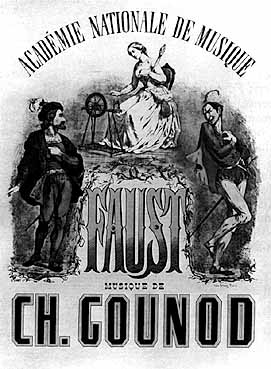
Showing posts with label faust. Show all posts

Aug 29, 2008

10 mistakes to avoid when planning an innovative staging of Gounod’s Faust

Staging orientations

  1. Don't make up Faust as an elderly cripple only to rejuvenate him as a flamboyant young man at the end of the act I.
  2. Don't display the catholics' rites too ostentatiously (death of Valentin, church scene, final scene "Christ est ressussité").
  3. Don't make Méphistophélès stand on a wooden barrel for the "Veau d'Or" aria.
  4. Don't portray Valentin provoking Méphistophélès with a crucifix ("C'est une croix" aria).
  5. Jewels aria: no literal or derivative version of a golden/silvery jewels box should appear onstage.
  6. Walpurgis Night: don't show semi-naked women or imitate in any way the Bacchus iconography.
  7. Final scene: don't make Marguerite wear a white immaculate frock, don't tie her with long ropes or chains cemented on the wall and ask her to adopt the position of crucifixion.

Costumes

  1. Don't dress Méphistophélès in red.
  2. Don't dress Marguerite in any "purity" colours: white, light blue, light pink.
  3. Don't dress the chorus with XIXth century military uniforms.

Aug 8, 2008

Faust, Orange


August 5 performance review


Nicolas Joël’s staging


Obviously, Joël’s view on Faust is centered around Marguerite.
The huge set in the background – a replica of the organ in the Narbonne’s cathedral – was designed to emphasize the church scene at the end of Act 4 where Marguerite seeks refuge feeling guilty after her brother’s death, only to be “welcomed” by Méphistophélès – effectively rushing her to madness, ultimately leading her to kill her child and being imprisoned and executed.

The libretto is quite rushing these events by the way – no doubt a main flaw to fluidity in this piece. On this level, Joël didn’t really help understand the story better; the duel scene in which Valentin (Marguerite’s brother) is killed by Faust, with the help of Méphistophélès, was conceptualized as a kind of “struck by lightning” moment with Faust and Valentin both static, with no sword in hand, and Méphistophélès killing Valentin by a casual fan movement.
I liked the idea very much, but people not familiar with the piece were clueless as to what was happening (I should know, I know some of these people).

Anyway, the church scene – staged as it was to be the counterpoint of the evening – was clearly a success, and I must admit the whole organ setting was indeed well thought of (as I managed to convince the couple sitting next to me of its relevance – though they were more than skeptical about it).

The rest of the production, I must say, was a disappointment: very conventional, very static, very boring. The costumes were unimaginative as well – except for Méphistophélès who was dressed as a circus host – a costume that didn’t suit René Pape’s silhouette (or lack of, rather) at all.


Michel Plasson’s direction

I still remember the first time I saw Plasson conducting, a decade ago, when I was a student in Toulouse.
He was trying to bring classical music to young people by performing free concerts exclusively for students – and there’s nothing more appealing to a student than the word “free”. He was conducting Mahler and his interpretation was full of life, energy and passion.

Neither of those components was to be found in Orange. His conduction was painfully slow, blend and apathic (from what I heard his performances of Carmen in Orange were equally bad). Moreover, the rhythm was awfully off on the fast arias, and clearly “Gloire immortelle de nos aïeux” was a disaster. This was kind of my last try with Plasson, and I must say I’m done for good with him.

From now on, his presence will dissuade me from attending a performance.


Supporting roles


My beloved Nicolas Testé as Wagner made a terrible entrance. His first sentence was an absolute nightmare and in such a small part, the first notes are decisive. The role of Siebel – a male role with a soprano line – was filled by a tenor (contrary to tradition) and I must say this choice actually worked pretty well for me – plus Xavier Mas as Siebel made a good impression on me. Marie-Nicole Lemieux’s Marthe was fun and entertaining, which is basically what the part demands, more than technical perfection.


Jean-François Lapointe as Valentin was praised by a lot of the audience (beautiful timbre and good singing) yet I could not get pass Ernest Blanc’s Valentin. At that point, I realize I probably never will and will remain unsatisfied by any performance. Inva Mula’s Marguerite was also a disappointment. The first part of the jewels aria, “Il était un roi de Thulé” was inaudible as it was obvious she was keeping her strength for the “Ah je ris de me voir si belle en ce miroir” part. The rest of her performance was OK I guess, but again, first impressions are unforgiving.


René Pape and Roberto Alagna


There is no doubt Pape has a great stage presence and is equally good in comic and dramatic situations. His high notes are splendid and incredibly convincing, but the lower lines –numerous in this part – are clearly his weakness. They all were perfectly hit on Thursday, but the volume level was too weak – even with the great acoustics of the Théâtre Antique. On the other hand, projection is not really an issue for Roberto Alagna. As expected, the live broadcast on France 2 brought out the best of him, vocally and most noticeably in the acting department. He’s not the fantastic Faust he used to be several years ago but his performance was superb – maybe some of the light vibratos on the high notes could have be prevented, but his stage presence was indeed one of the best I’ve seen of him since 3-4 years.


Conclusion


The review – as always with me – may be mixed – mitigé as we say in French – but there’s one thing unique in Orange – especially for someone like me living in the heart of a big city: attending an opera performance literally under the stars is a one-of-a-kind experience: the beauty of the music is an amazing complement to the wonders of the Universe.


French légionnaires watching over the performance


Jan 1, 2008

Preview; Faust in Orange

Affiche pour la 500e lithographie de Auguste Lamy Bibliothèque-Musée de l'Opéra http://www.charles-gounod.com/
I've finally given up to the outrageously expensive tickets for the Orange Summer Festival. And will attend one performance of Gounod's Faust. My regular reading of several blogs sure had a great influence on this decision, as well as a friend constantly telling me the acoustics there, alongside the size of the audience is actually an amazing experience in itself. The blogs had an impact on the cast, since I tend to trust more people I can have a general sense of their taste (as well as beloved Le Monde's writer Renaud Machart, of course). Supposedly, the recent performances of Alagna in the MET's Aïda were great. Plus, he always has been a great Faust, at least until 2005.

This one always chats about how fantastic René Pape is, and since he almost exclusively sings Wagnerian operas, Faust is indeed one of the only occasions I truly have to appreciate his singing (of course he'll have to master the very difficult part of Méphistophélès first with special care to the beginning of the church scene in act IV, if it's not too much to ask).

Inva Mula could make a good, if not great, Marguerite, though I must admit I already prepare for the worst in the marathon that is the famous jewels aria. Nicolas Testé will be a real joy to hear again, even if it's only for a few sentences.

Marie-Nicole Lemieux made a good impression in Paris recently, but then again, the part of Dame Marthe is almost insignificant. I've never actually heard the part of Siebel being sung by a male singer, despite my numerous recordings of this opera, so it should be interesting enough.

The part that really scares me, though, is the one of Valentin. The brother of Marguerite has some amazing arias to sing, specifically "Avant de quitter ces lieux" and "Ecoute moi bien, Marguerite", the aria he dies after. Not even to mention the great "C'est une croix". Valentin is the part I love most in Faust. The baritone singing it must really own the score to make it work, and that's no easy job to master. As a matter of fact, all the Valentins I know range from average to pretty bad. All but Ernest Blanc. Is unknown Jean-François Lapointe up to the challenge? I fear he isn't.

Another fear I have is conductor Michel Plasson. He could alone ruin the whole thing. He is supposedly great at understanding French operas, but I'm sorry, he sucks. He destroyed Les Pêcheurs de Perles, his recording of Gounod's Mireille (scheduled for 2010 in Orange with him, once again) is a must-have only because it's the only decent one available, but it does definitely not showcase Gounod's music at its best.

The staging could be less boring than the average standard in Orange, considering Nicolas Joël, soon to become the new director of the Paris Opera, wouldn't put up a dumm concept knowing everybody is watching him. On the other hand, he could.

Finally a word of advice to those who might want to come and see this Faust this summer. You do not want to be trapped on one of the biggest travelling week-ends of the year, aka forget about the August 2nd performance unless the perspective of spending countless hours stuck in traffic or in crowded train stations is one of those you embrace.

Dec 5, 2007

Orange 2008


Next summer in Orange, Les Chorégies will feature two French operas from the XIXth century; world famous Bizet's Carmen (July 12 and 15) and Gounod's Faust (August 2 and 5). The Carmen cast includes Marcelo Alvarez (Don José), Béatrice Uria-Monzon (Carmen) and impressive French mezzo Karine Deshayes (Mercédès), all conducted, as usual in Orange, by Michel Plasson. Nadine Duffaut will direct the opera, and that's an awful news to me (her staging of last year's Les Pêcheurs de Perles in Avignon was dreadful, to say the least). Faust will feature Roberto Alagna (Faust), René Pape (Méphistophélès), Inva Mula (Marguerite) and sensational French bass Nicolas Testé as Wagner (too bad the part is so small), all under the conducting of Michel Plasson - again. Nicolas Joël will direct this cast, for his last staging before taking over the Paris Opera. French TV channel France 2 will broadcast Faust live, as it did last summer with Orange's production of Il Trovatore, with was successful enough to allow this second broadcast. Also worth noticing, the performance of Fauré's Requiem on July 26 in the Cathédrale Notre Dame d'Orange, to commemorate its 800-year existence. Online booking is available, prices range from €220 to €48 (for Faust and Carmen). Preview for the 2009 Summer: - Traviata with Patrizia Ciofi - Pagliacci and Cavalleria Rusticana with Roberto Alagna and Béatrice Uria-Monzon Preview for the 2010 Summer: Gounod's Mireille, probably once again conducted by Michel Plasson, with Franck Ferrari and Karen Vourc'h (Vincenette).

Official website of Les Chorégies.

Oct 25, 2007

Critique d'époque


About Gounod's Faust (I love the first few words) ;
" Taisez-vous, troupe de mouches, car le choeur des enthousiastes s'avance et va couvrir de sa grande voix vos monotones bourdonnements. Ils sont nombreux les enthousiastes de M. Gounod, ceux qui comprennent son talent et qui l'admirent, ceux qui s'inclinent devant le jeune maître et osent le suivre dans les hautes régions qu'il habite. Je me joins à eux pour proclamer le grand succès de Faust, succès de bon aloi qui repose sur le mérite de l'oeuvre." Ernest Reyer, extrait d'un article paru dans Le Courrier de Paris, réimpression sous le titre Quarante Ans de Musique (non daté)

My translation ;
" Quiet, troops of flies, the chorus of enthusiastic people is moving forward and will cover with its majestic voice your monotonus buzz. The enthusiasts of mister Gounod are everywhere, they understand his talent and admire it, they bow before the young master and dare to follow him in the higher realms he lives in. I join them to proclaim the great success of Faust, a worthy success that lies on the merit of the work."

Mar 18, 2007

Faust, MET, March 17, 2007


And you, what did you do last evening ?
I personally listened to the MET live broadcast of Gounod’s Faust.


CAST

Marguerite: Ruth Ann Swenson
Siébel: Karine Deshayes
Faust: Ramón Vargas
Valentin: Hung Yun
Méphistophélès: Ildar Abdrazakov
Conductor: Maurizio Benini


Mary Sohl / Metropolitan Opera


The overall performance was good, not great, one of those I won’t probably remember in a couple of years.


Ramon Vargas, supposedly one of the best tenors in the world right now was a disappointment, especially in the first act, where, apart from his unimpressive skills to pronounce French properly, he had some bad notes here and there.
He was much better later on, but in the love act, the third one, he was not very credible either.


Hung Fun’s Valentin was equally average, with some problems on low notes especially at the enc of act four (when he dies).

Ildar Abdrazakov as Méphistophélès had some sparkles, as did Karine Deshayes singing Siébel.


Maurizio Benini gave a solid interpretation of Gounod’s score, cutting (as so often with this piece) the first scene of Act IV, as well as the first scene of Act V (a cut rarely done).
But, in my mind, Faust is one of these operas you can’t really conduct poorly, the score being so straightforward and coherent from beginning to end.


The real surprise for me was Ruth Ann Swenson, whose Marguerite was very unique and very attractive (though she had some problems at the end of long aria such as the Jewel song), a well-balanced mixture between her naïve moments and her dark side.


This MET’s production of Faust was created in 2005 by Andrei Serban and received a lot of critics. Further info in this NY Times article from Allan Kozinn.


Lucy Arner on Faust: "Simple is not simplistic".


Mar 10, 2007

Faust, Gounod


A l’occasion de la sortie, dans le Monde de ce samedi, du Faust de Gounod, un de mes opéras favoris ;


Charles Gounod


Créé en 1859, Faust a été traduit en 34 langues dans 45 pays et fête sa millième représentation dès 1894 (2000e en 1934); il fait l’inauguration du Metropolitan Opera de New York en 1883, et y est repris en ce moment, avec une retransmission en direct samedi prochain 17 mars à 18h30 (avec Ramon Vargas dans le rôle de Faust).


Projet présenté à l’Opéra de Paris (et refusé) en 1856, Léon Carvalho, directeur du Théâtre Lyrique accepte l’œuvre, puis se rétracte, pour finalement revenir sur sa décision en 1859.


Le livret, d’après le Premier Faust de Goethe, est commandé en 1856 par Gounod au duo Michel Carré / Jules Barbier, après qu’il ait été conquis par la pièce de Michel Carré, Faust et Marguerite, centrée autour de l’intrigue amoureuse et du sort de Marguerite.


La partition à peine achevée, en septembre 1858, les répétitions commencent au théâtre de la Porte Saint-Martin, avec Marie Miolhan-Carvalho dans le rôle de Marguerite (l’épouse de Léon Carvalho, qui obtint le rôle à la demande expresse de son mari mais qui visiblement campa une Marguerite remarquable), Emile Balanqué en Méphistophélès et Hector Gruyer, « Guardi » en Faust, dont la prestation en répétitions ravit Gounod mais dont la voix s’effondre le jour de la générale (causant le report de la première) et qui est écarté (d’aucuns devraient s’en inspirer) et remplacé par le provençal Joseph-Théodore-Désiré Barbot, élève de François Desarte, qui apprend le rôle monumental en à peine trois semaines, dont la prestation impressionne Bizet (qui considérait l’opéra maudit après les mésaventures de Gruyer) et Berlioz.
Siebel est créée par Melle Faivre, alors que Valentin est chanté par Raynal.


L’opéra connaît un succès mitigé après la première le 19 mars 1859, du fait de sa rupture avec la tradition du Grand Opéra.


La vente de la partition et des morceaux détachés, le jugement de musiciens éclairés (Berlioz, Bizet, Debussy, Busoni ou Stravinsky) et le succès de Roméo et Juliette et Mireille concourent au triomphe en 1869 (version révisée en supprimant les parties parlées entre les airs, présentes dans la partition originale, par des récitatifs ; à laquelle Gounod ajouta de plus les ballets ouvrant l’acte V), lors du retour sur la scène de l’Opéra.
La 500e a lieu dès 1886, sous la direction de Gounod lui-même.


Comment ne pas rendre grâce aux qualités musicales indéniables de la partition, au premier lieu desquelles une richissime écriture vocale, avec cinq personnages principaux balayant toutes les tessitures : Faust, ténor ; Marguerite, soprano colature ; Méphistophélès, basse ; Valentin, le frère de Marguerite, baryton ; et Siebel, mezzo, s’inscrivant dans la tradition française des travestis ?


Tous les autres ingrédients d’un grand succès sont présents dans la partition de Gounod ; une orchestration raffinée, des chœurs énergiques (« Vin ou bière » à l’acte II, « Gloire immortelle de nos aïeux » à l’acte V …), une incroyable richesse mélodique (divine cavatine de Valentin à l’acte II « Avant de quitter ces lieux » ; première rencontre entre Faust et Marguerite à la fin de l’acte II « Ne permettrez vous pas » ; air de Faust à l’acte III « Salut ! Demeure chaste et pure » ; airs de Marguerite « Il était un roi de Thulé » et le célébrissime air des bijoux à l’acte III, duo Faust/Marguerite « O nuit d’amour, ciel radieux » toujours à l’acte III ; sérénade de Méphistophélès à l’acte IV « Vous qui faites l’endormie », duo final entre Faust et Marguerite « Oui, c’est toi, je t’aime » …), des scènes de ballet (début de l’acte V), et des scènes intimes (« J’ai languis, triste et solitaire » de Faust, ouvrant l’opéra ; scènes de Marguerite à l’acte III …) rompant définitivement avec le Grand Opéra à la Française, dont La Juive (Gounod a été l’élève d’Halévy au conservatoire).


La partition a néanmoins été passablement modifiée avant la première, à la demande de Carvalho qui exigea notamment que Gounod supprime l’air de Valentin « Chaque jour nouvelle affaire » à l’acte IV, remplacé par le chœur « Gloire immortelle » que Gounod récupéra d’un opéra inachevé, Ivan le Terrible ; de même, la fameuse scène de l’église fut déplacée à la fin de l’acte IV (et supprimée lors de la première à la demande du Ministre des Beaux-Arts pour éviter toute tension avec le Vatican, dans le contexte politique houleux de l’époque).


La version présentée par le Monde ce samedi est un enregistrement live de 1973 (remastérisé par la NHK en 2007) d’une très bonne facture (à part Lorenzo Saccomani dans le rôle de Valentin, mais comment soutenir la comparaison avec Ernest Blanc en même temps), avec une mention particulière à l’orchestration de Paul Ethuin et à la prestation remarquable d’Alfredo Kraus.

Faust : Alfredo Kraus
Marguerite : Renata Scotto
Méphistophélès: Nicolaï Ghiaurov
Valentin: Lorenzo Saccomani
Siebel : Milena Dal Piva
Marthe : Anna Di Stasio
Wagner: Guido Mazzini
Chœurs et orchestre de la NHK de Tokyo
Direction : Paul Ethuin

Extrait Youtube de cette version:
Final de l'acte V


Version indispensable :


EMI Classics, 1959 version
Faust: Nicolai Gedda
Marguerite: Victoria De Los Angeles
Méphistophélès: Boris Christoff
Valentin: Ernest Blanc
Siebel : Liliane Berton
Marthe : Rita Gorr
Wagner : Victor Autran
Chœurs et orchestre du Théâtre National de l’Opéra
Direction : André Cluytens


Post réalisé à partir des textes parus dans les versions CD ci-dessus ainsi que dans le Monde 2 (p62) de ce jour et dans le livret du DVD de 1985 du Vienna State Opera dirigée par Erich Binder.


Extraits choisis de Youtube :

- scène de l'église avec Marguerite (Angela Gheorgiu) et Méphistophélès (Bryn Terfel) dans la version 2004 du Covent Garden (direction Antonio Pappano)
- « laisse ta main s’oublier dans la mienne », duo entre Marguerite (Angela Gheorghiu) et Faust (Roberto Alagna) dans la même version
- toujours dans la version de Covent Garden, extrait de l’acte I, « A moi les plaisirs », Faust et Méphistophélès

- mort de Valentin (fin de l’acte IV), dans la production de décembre 2006 à Come et Modène (Italie) avec Javier Franco (Valentin), dirigée par Philippe Auguin
- « avant de quitter ces lieux » air de Valentin (acte I) par Simon Keenlyside dans la production de 2004 du Covent Garden


Feb 5, 2007

Michel Carré


Parce que tout ne se trouve pas encore sur Internet, voici une petite liste d’informations récoltées à grands coups de Google concernant Michel Carré (Paris 1819 - Argenteuil 1872), un des grands librettistes du 19e siècle en France.


Elève de Delaroche avec Le Gray et Gérôme, il abandonna vite la peinture pour devenir un librettiste à succès.
On lui doit ;


Collaborations avec Eugène Cormon:

- Quentin Durward, opéra comique en 3 actes de François-Auguste Gevaert, d'après Walter Scott, créé le 25 mars 1858
- Le Diable au Moulin, opéra comique en 1 acte de François-Auguste Gevaert, créé le 13 mai 1859
- Le Château Trompette, opéra comique en 3 actes de François-Auguste Gevaert, créé le 23 avril 1860
- Les Pêcheurs de Perles (1863), livret ici, opéra en 3 actes de G.Bizet, créé le 30 septembre 1863 au Théâtre Lyrique
- Lara, opéra comique en 3 actes et 6 tableaux, musique de Louis-Aimé Maillart, créé en 1864
- Le docteur Magnus, d'après Pyron, opéra comique en un acte d'Ernest Boulanger, créé à l'Opéra Comique le 21 mars 1864


Coécriture avec Jules Barbier de quasiment tous les opéras de Charles Gounod :
- Le médecin malgré lui,
opéra comique en 3 actes d’après Molière, créé le 15 janvier 1858 au Théâtre Lyrique
- Faust, opéra en 5 actes, d'après la pièce Faust et Marguerite de Carré, elle-même tirée du Premier Faust de Goethe en 1808 ( livret ici), créé le 19 mars 1859 au Théâtre Lyrique
- Philémon et Baucis, opéra comique en trois actes, créé le 18 février 1860 au Théâtre Lyrique
- La Colombe, opéra comique en 2 actes, créé à Baden-Baden le 3 août 1860
- La Reine de Saba, opéra en 5 actes, d’après Le voyage en Orient de Gérard de Nerval, créé le 28 février 1862 (en 4 actes) à l'Opéra de Paris
- Roméo et Juliette, opéra en 5 actes, d’après Shakespeare (livret ici), créé le 27 avril 1867 au Théâtre Lyrique
- Polyeucte, opéra en 5 actes, d’après la pièce de Corneille, créé le 7 octobre 1878 à l'Opéra de Paris


Ambroise Thomas (prix de Rome 1832);
- Mignon (1866, Opéra-comique en trois actes et quatre tableaux d’après le roman de Goethe, Les années d’apprentissage de Wilhelm Meister )
- Hamlet (d’après la pièce de Shakespeare, livret ici).

Opéras comiques de Victor Massé (1822-1884);
-
Galathée (1852, Opéra comique en 2 actes : "Ah! Qu'il est doux de ne rien faire quand tout s'agite autour de vous"
- Les noces de Jeannette (1853, Opéra-comique en 1 acte).

Opéras comiques d’Ernest Boulanger (prix de Rome 1835):
- Les sabots de la marquise
(1854, opéra comique en un acte)
- L’Eventail (1860, opéra comique en 1 acte)
- Don Quichotte, opéra comique en 3 actes et 4 tableaux d'Ernest Boulanger, créé au Théâtre Lyrique le 10 mai 1869
- Don Mucarade (1875, opéra-bouffe en un acte d’après le Barbier de Séville)


Autres productions conjointes:

- Deucalion et Pyrrha
, opéra en 1 acte d'Alexandre Montfort, créé le 8 octobre 1855 à l'Opéra Comique
- Les Papillottes de Monsieur Benoît, opéra comique en 1 acte de Napoleon Henri Reber créé le 28 décembre 1853 à l'Opéra Comique
- Dinorah ou Le Pardon de Ploërmel, d'après la pièce de Michel Carré, Les Chercheurs de trésor, opéra comique en 3 actes de Giacomo Meyerbeer, créé le 4 avril 1859 à l'Opéra Comique


Inspirateur du livret des Contes d’Hoffmann (1881), écrit par Jules Barbier (Offenbach) tiré de la pièce de Carré et Barbier (1851) basée sur les contes d'Ernst Theodor Amadeus Hoffmann (livret ici).


Avec Léon Battu ;
- Le Mariage aux Lanternes (1857), opérette de salon en un acte de 35 minutes, musique de Jacques Offenbach

Avec Beauplan ;
- L'amour mouillé, opérette d'Edouard de Hartog, créée en 1868 au Théâtre des Fantaisies Parisiennes

Avec Adolphe de Leuven ;
-
Choisy-le-roi, opéra comique en 1 acte de Jean François Eugène Gautier, créé le 14 octobre 1852 au Théâtre Lyrique
- Schahabaham II, opéra bouffe en 1 acte de Jean François Eugène Gautier, créé le 31 octobre 1854 au Théâtre Lyrique

Avec Adolphe de Leuven et Hadot ;
- La Saphir, opéra comique en 3 actes de Félicien David, créé le 8 mars 1865 à l'Opéra Comique

Avec Hippolyte Lucas ;
-
Lalla Roukh , opéra comique en 2 actes de Félicien David, créé le 12 mai 1862 à l'Opéra Comique

Avec Jules Édouard Alboize de Pujol et Arthur Saint-Léon ;
- Le Lutin de la vallée,
légende en 2 actes de Jean François Eugène Gautier, créé le 23 janvier 1853 au Théâtre Lyrique
- Le danseur du roi, opéra-ballet en 2 actes de Jean François Eugène Gautier, créé le 22 octobre 1853 au Théâtre Lyrique


Auteur (seul) des livrets de:
  • Mireille (1864, Gounod, d'après le poème de Frédéric Mistral Mireio)
  • Le mariage aux lanternes (opérette en 1 acte, 1857) et La Rose de Saint-Flour (Offenbach)
  • Le Chevalier Lubin (opéra comique en 1 acte, créé le 23 mai 1866 aux Fantaisies Parisiennes) de Louis Boieldieu
  • La captive, opéra comique en 3 actes de Félicien David (1864), créé à titre posthume à l'Opéra Comique en 1883


Dec 1, 2006

Blind test #1

To start the week-end, I thought I might interest you with a little blind test. So, which opera is that extract from?

The winner will have no prize but my deepest consideration.

Oct 21, 2006

De l’enfer qui vient émousser nos armes.

(Valentin & chorus, Act II) I was living with this girl. And things were getting so bad the end was just a question of weeks. I was so overwhelmed. And so powerless too. What do I do when I feel powerless and overwhelmed? I turn to music. Or, to be accurate, music makes a way into my brain, the only viable way. I have a strange brain you see. When bad things (or good, for that matter) happen to me, my brain connects instinctly with some music I know that best describes the situation. It has happened to me quite a few times. In that particular occasion, that aria from Gounod’s Faust became my way of letting it go. I was obsessed with it, listened to it all the time (thanks ever so dear for the Sennheiser headphone), couldn’t not sing it in my head when there was some free time I couldn’t spend thinking about how awful the situation at home had become. I am mad or I am mad about music?

Oct 18, 2006

Charles Gounod

Thanks to Radio Classique, who broadcasted Mireille by Charles Gounod last Sunday evening (Freni, Vanzo, Plasson 1988 version), I've started listening again to Gounod's three masterpieces: Faust (1859), Mireille (1864) and Roméo & Juliette (1867), a thing I had not done in quite a long time now.

Two things I love in Gounod's music: the rhythm and the melodies.

A few examples from YouTube; From Faust, "Avant de quitter ces lieux" (Valentin aria) sung by Leonard Warren, "Quel trouble inconnu me pénètre" (Faust) by Nicolai Gedda and "Salut demeure chaste et pure" (Faust) by Alagna (2004). Unfortunately, I couldn't find any performance of "De l'enfer qui vient émousser nos armes", an aria (chorus & Valentin) that has a very special meaning for me. From Roméo & Juliette, "Ah lève toi Soleil" (Roméo) also sung by Alagna (1994). I couldn't find anything from Mireille, nevertheless I recommand "Voici la saison mignonne" (Act 2, disc 1 track 9 in the EMI version by Plasson).

The YouTube extracts are also a good opportunity to compare Alagna's singing from 1994 & 2004, and of course realize in dispair how good he was and how mediocre he's becoming. It's a slippery slope Roberto, a very slippery slope...

My favorite recordings of Gounod:

Faust EMI Classics, 1959 version Conducted by André Cluytens Faust: Nicolai Gedda Marguerite: Victoria De Los Angeles Méphistophélès: Boris Christoff Valentin: Ernest Blanc

Roméo et Juliette EMI Classics, 1998 version Conducted by Michel Plasson Roméo: Roberto Alagna Juliette: Angela Gheorghiu Frère Laurent: José Van Dam

Mireille EMI Classics, 1988 version (I never heard any other recording) Conducted by Michel Plasson Mireille: Mirella Freni Vincent: Alain Vanzo Ourrias: José Van Dam