Showing posts with label callas. Show all posts

Sep 16, 2007

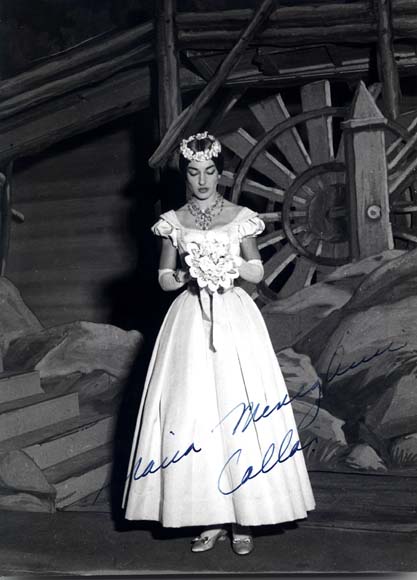
In Memoriam : Maria Callas

[Dec.2, 1923 – Sept.16, 1977]

“J’ai perdu mon Eurydice”, Orphée et Eurydice, Gluck

Milano 1958, SAMA/SIPA
Legendary roles:
1. Norma, Bellini 89 performances from 1948 (Firenze) to 1965 (Paris) One version to own: the 1960 EMI studio recording (for Franco Corelli).

“Casta Diva”, 1955 live recording, Antonino Votto conducting

2. Violetta, La Traviata, Verdi 63 performances from 1951 (Firenze) to 1958 (Dallas) One version to own: the 1958 Lisbon live recording, Franco Ghione conducting. One version to ban at all cost: the 1955 live recording with the unbearable direction of Carlo Maria Giulini.
Maria Callas as Violetta, RUE DES ARCHIVES
3. Lucia di Lamermoor, Donizetti 46 performances from 1952 (Mexico) to 1956 (Vienna) One version to own: the 1955 live recording, Herbert Von Karajan conducting (with the sound of a plane above the opera house during the mad scene). 4. Tosca, Puccini 46 performances from 1942 (Athens) to 1965 (London) One version to own: the 1953 EMI studio recording, Victor De Sabata conducting. 5. Aïda, Verdi 33 performances from 1948 (Torino) to 1953 (Verona) One version to own: the 1955 EMI studio recording, Tullio Serafin conducting, with Tito Gobbi, Richard Tucker and Nicola Zaccaria. 6. Medea, Cherubini 31 performances from 1953 (Firenze) to 1962 (Milano) One version to own: the 1953 EMI live recording (from La Scala), Leonard Bernstein conducting. 7. Turandot, Puccini 24 performances from 1948 (Venezia) to 1949 (Buenos Aires) One version to own: the 1957 EMI studio recording, Tullio Serafin conducting the orchestra and chorus of Il Teatro alla Scala, with Elisabeth Schwarzkopf and Nicola Zaccaria. 8. Amina, La Sonnambula, Bellini 22 performances from 1955 (Milano) to 1957 (Edimburgh) One version to own: the 1955 EMI live recording, Leonard Bernstein conducting the orchestra and chorus of Il Teatro alla Scala. 9. Leonora, Il trovatore, Verdi 20 performances from 1950 (Mexico) to 1955 (Chicago) One version to own: the 1956 EMI studio recording, Herbert Von Karajan conducting the orchestra and chorus of Il Teatro alla Scala, with Giuseppe DiStefano, Rolando Panerai and Nicola Zaccaria. 10. Elvira, I Puritani, Bellini 16 performances from 1949 (Venezia) to 1955 (Chicago) One version to own: the 1953 EMI studio recording, Tullio Serafin conducting the orchestra and chorus of Il Teatro alla Scala, with Giuseppe DiStefano and Rolando Panerai.

Sep 10, 2007

Best bargain on anything, really


Maria Callas, Norma, Paris 1965


Because, well, you know, there's nothing best than making money off dead people, a collection of Maria Callas stuff is to be auctioned by Sotheby's Milan on Dec.12 2007.

The package includes 63 love letters from Callas to Giovanni Battista Meneghini, photographs of Callas on stage, evening gowns, musical scores, and really anything you can make money off.

Sep 7, 2007

Callas on YouTube


This is why YouTube is a bad idea for people like me who can't sleep: it just doesn't help. Some great videos I found;
  • an interview (a discussion rather, and a very friendly one) with Lucchino Visconti (in French)
  • a German report (I don't speak German either folks) about the Norma that opened the 1960-61 Scala season; I truly recommend the way Maria ends the interview (in Italian) with two quick "danke danke" (6 min 34) and the Pierre Balmain interview (in French, 4 min 11) that has nothing to do with opera but everything with the evening gowns
  • an extract of one of the masterclass Maria gave at the Juilliard School of Music, New York in 1971-72 (sound only); how to sing "Cortigiani, vil razza dannata" from Rigoletto
Other wanderings;
  • "Huayno Peruano Navideno" performed by Juan Diego Florez and the Vienna Boys Choir (aka when opera meets traditional South American music);
  • Franco Corelli getting ready for Christmas, relaxing on a picnic with his wife Giulietta Simionato (I especially admire the "peach knife art") & the opening of the 1961 season of the Arena di Verona (aka when Paris Match meets opera);
  • Glenn Gould playing Bach (aka when Asperger meets classical music);
  • Paul Potts singing "Nessun dorma" from Puccini's Turandot (for those who have miss this aria played everywhere yesterday to illustrate the way Pavarotti sang - especially a good example with his performance during the 2006 Winter Olympics in Torino though [could journalists know less about singing, I wonder]-), aka when opera meets reality TV


Aug 12, 2007

Ode à une époque révolue


Extrait de Télérama, 18 juillet 2007.


Rosa Ponselle
1897-1981


To (re)discover the great voice and singing of this italian-american soprano, I strongly advise you to check this page [complete biography here, in French].

Especially moving is the extract from Spontini's La Vestale, "O Nume tutelar" [direct link to the mp3 here].

Well, let's face it, every extract is sublime.


Mar 24, 2007

[Ears openers] III. Maria Callas


Everything has already been said and written about La Callas.
So I’m not gonna add another enthusiastic post from another unconditional fan.


I just wanted to let you be the judge.
I’ve selected 4 extracts from YouTube, from the 4 major female roles in Italian opera; Amina in Bellini’s La Sonnambula, Lucia from Donizetti’s Lucia di Lammermoor, Norma from Bellini’s Norma and Violetta from Verdi’s La Traviata.


I’m giving you the YouTube version of Maria Callas I prefer, as well as the other version I fancy (from anyone but Callas).

There’s no brainstorming on these extracts for me.
However great the other singer is (and I must admit Ciofi as Lucia, Gheorghiu as Violetta and Dessay as Amina are pretty amazing), Maria Callas is still singing in another galaxy.


Amina – La Sonnambula – two extracts from two recitals of the same aria, “Ah! non credea mirarti”
The Callas recital, the 2006 New York performance of Natalie Dessay.


Lucia – Lucia di Lammermoor – two live performances of the Mad Scene.
The Callas 1955 live from Berlin (part one, part two), the 2006 Orange performance of Patrizia Ciofi (part one, part two).


Norma – Norma – two live performances of “Casta Diva”
The Callas 1955 Opening night at La Scala (sound only), the 1974 Orange performance of Montserrat Caballé.


Violetta – La Traviata – two live performances of “Sempre libera”
The Callas 1951 live from Mexico City (sound only), the 1994 Covent Garden performance of Angela Gheorghiu.


Further readings

- An article published in Time Magazine on Callas, written by Cecilia Bartoli
- Interviews of Maria Callas in French (1965 and 1969), extracts from the INA archives (other extracts here)

- French site exclusively about Maria Callas
- La Divina Maria Callas (in Italian and in English)
- listing of main sites about Callas


Nov 10, 2006

Compte-rendu de la Sonnambula, Part I

Soirée du 9 novembre 2006


Natalie Dessay ........ Amina
Franceso Meli ........ Elvino
Carlo Colombara ........ Il conte Rodolfo
Jaël Azzaretti ........ Teresa

Evelino Pido
Choeurs et orchestre de l'Opéra de Lyon
version de concert


La version donnée au cours de ces trois concerts est l’édition critique établie par Allessandero Roccatagliati et Luca Zoppelli, publiée par Ricordi, qui a été débarrassée des scories accumulées au fil du temps et représente la version la plus proche de la partition originale de Bellini.


Possédant deux versions live de la Sonnambula, celle de Votto en 1957 à Cologne avec la Callas, Nicola Monti (Elvino) et Nicola Zaccaria (Rodolfo) et celle de Santi en 1961 à la Fenice avec Renata Scotto, Alfredo Kraus et Ivo Vinco (qui n’arrive pas à la cheville de la précédente, malgré la présence de Kraus), j’ai effectivement remarqué des différences avec la version donnée hier: des transpositions d’un demi-ton en dessous dans deux airs d’Elvino, ainsi qu’une orchestration revue avec notamment disparition des doublons dans les vents et une sonorité plus « musique de chambre » à certains passages.

La force de l’habitude aidant, j’avoue que je ne suis pas très réceptive à ces modifications (mais enfin, si c’est la partition originale de Bellini, je ne peux que me taire).


Quelques petites remarques désagréables pour commencer ;


- Le cor responsable d’un couac mémorable au milieu de l’acte I est prié de se dénoncer.
Ils n’étaient que 4 sur scène, et personnellement je penche pour le cor au 1er rang côté cour.

- La gestuelle d’Evelino Pido, ça devient vraiment n’importe quoi.
Voilà que maintenant il dirige avec une main dans la poche (pendant une minute entière, alors que l’orchestre jouait). Néanmoins son enthousiasme en fin de 2e acte faisait plaisir à voir.
Sa complicité avec Dessay aussi.


- Si Carlo Colombara replante son solo « vi ravviso, o luoghi ameni » (acte I) comme hier le 19, je le huerai. Pour de vrai.
Les airs de basse sont notoirement les solos qui me font chavirer et celui-ci est particulièrement sublime. Alors que tout se déroulait sans encombre, arrivé aux vocalises sur « Non trovo piu », deux horribles râlements sont sortis de sa bouche au lieu des notes escomptées. Détruisant tout le solo. Je n’avais jamais entendu un raté pareil.
Ahurissant.

- Le cas Francesco Meli (Elvino) :
Tout jeune ténor italien (il a 26 ans), je l’ai détesté dès son apparition sur scène.
Maniéré, soignant la diction plus que le chant, il s’est agréablement calmé en cours de représentation, s’améliorant même notoirement entre le 1er et le 2nd acte. Certes, je trouve sa voix trop aiguë, mais il a chanté globalement de façon honorable.

- Paul Gay (Alessio) a fourni une prestation tout aussi insignifiante que la part du rôle dans la partition.

- Jaël Azzaretti, qui remplaçait Sophie Karthäuser dans le rôle de Lisa s'est montrée correcte, avec quelques éclats notamment sur le quatuor (+chœur) de l’acte 2 « signor Conte, agli occhi miei »

- La contralto Sara Mingardo (Teresa) était un délice à écouter. C’est bien la première fois que je regrette que le rôle de la mère d’Amina soit aussi peu fourni.


Natalie Dessay pour terminer.


Ah la la.

Si on m’avait dit un jour que je pleurerais sur des vocalises féminines, je ne l’aurais jamais cru.
Je ne suis déjà pas très sensible aux aigus, mais en plus les vocalises, je trouve que c’est une prouesse technique en général inutile et sujette à désastre.

L’amour que je porte à Bellini tient à une multitude de raisons, et l’une d’entre elles est que ce compositeur a su rendre émotionnelles les vocalises qu’il a imaginé.

Natalie Dessay a su retranscrire cette émotion de manière magnifique, particulièrement à la fin de l’acte 2 (retrouvailles avec Elvino).

De toute façon, je n’ai que compliments à lui adresser.
(dans un souci d’honnêteté, je dois reconnaître que sa voix a paru voilée à deux reprises sur une mesure)

Dieu que cette opération lui a réussi.
Sa voix est devenue plus chaude, plus mûre, simplement plus belle.

Sa performance a été magistrale, me coûtant quelques sueurs aux yeux à différents moments et une véritable hémorragie oculaire sur sa scène finale.

Comme le disait un spectateur à sa femme , « j’espère que tu en as bien profité, des prestations de cette qualité, tu n’en reverras pas avant longtemps ».

Oh si !
Dans 9 jours très précisément.
Can’t wait !


Complément (rajout du 6 mars 2007):

Le programme de cette Sonnambula (édité par l'Opéra de Lyon) est disponible en pdf ici.