Showing posts with label alagna. Show all posts

Aug 8, 2009

Pagliacci, Orange

I Pagliacci
Ruggiero Leoncavallo
Dramma in due atti (1892)
Libretto Ruggiero Leoncavallo

Nedda - Inva Mula
Canio - Roberto Alagna
Tonio - Seng-Hyou Ko
Silvio - Stéphane Degout
Beppe - Florian Laconi
Orchestre National de France
Choeurs des opéras de région
Georges Prêtre, direction
Mise en scène, Jean-Claude Auvray

France 3 live broadcast of the Aug.4 performance
Chorégies d'Orange


If I had the opportunity to choose an opera to stage, I would choose Pagliacci.
First of all, for very personal reasons, I love "le Théâtre dans le Théâtre" or, in this case, "le cirque dans l'opéra". It automatically carries, for me, a deep sense of Absurd that is longing to be explored. Yet I haven't seen any production of Pagliacci that focuses on this aspect. This one included.

Can you imagine what a director familiar with Harold Pinter's work would do with such a piece? Clearly Jean-Claude Auvray never heard of Pinter.

His one big idea, changing the end of the opera by having Canio kill himself is the ultimate misreading of the libretto. This is not an opera about death, although Nedda and Silvio actually die, this is about life. Canio's life. And his rebirth, after killing his unfaithful wife and her lover.

There is so much to explore in this piece without altering its meaning, and yet Auvray chose the easy path - making it more dramatic (or totally idiotic) by having Canio commit suicide. Les mots me manquent. How did he dare? It is so hard to really read the libretto, written by Leoncavallo himself, and try to play with lines such as Canio's "Il teatro e la vita, Non son la stessa cosa." ?


The conduction of Georges Prêtre was fortunately on a whole different level. There was a very cinematographic feel to it and it blended the music perfectly with Orange's Théâtre Antique.
At one point during the love scene between Nedda and Silvio, with the wind blowing in Inva Mula's hair, I felt like I was watching a movie from the sixties (which only shows how different a live performance and a broadcast really are, regardless of the size of the TV screen).

In any case, Prêtre's conduction was fresh and truly vibrant. The contrast between his music and the physical appearance of this now very old man is really mind-blowing.

As for the cast, Inva Mula gave a forgettable performance - not bad, but not particularly exciting as well. Roberto Alagna was not very convincing either, but substituting singing with shouting hardly ever is. And his "Recitar... vesti la giubba", the highlight of the score for me, fell terribly short I'm afraid.

Song Hyon Ko was the best of the cast. His singing was full of colours and nuances, the voice was well-placed, and the acting was convincing enough. A really interesting portrayal of Tonio by Ko.

Jan 11, 2009

Rondine from the Met


La Rondine 
Giacomo Puccini
Opera in 3 acts
Libretto Giuseppe Adami
Premiere Théâtre de Monte Carlo, March 27 1917

Magda: Angela Gheorghiu
Lisette: Lisette Oropesa
Ruggero: Roberto Alagna
Prunier: Marius Brenciu
Rambaldo: James Courtney

Conductor: Marco Armiliato
Production: Nicolas Joël
Set Designer: Ezio Frigerio
Costume Designer: Franca Squarciapino
Lighting Designer: Duane Schuler

Premiere in Toulouse in March 2005, performed in San Francisco in Nov. 2008
Jan.10 Arte broadcast live from the Met

Synopsis here and there, libretto (Italian only) here

 
Act 1, Terrence McCarthy
 
Act 2, Terrence McCarthy

 
Not much to say about this production of Nicolas Joël, except for the obvious word that comes to mind: boring. The set, the costumes, the lights, the actors' direction, everything is very very forgettable.

His dollhouse version of La Rondine lacks any kind of statement, exploration of characters, work on the relationships between the characters, any kind of analysis really. As for the muscial performance, Marco Armiliato's reading of the score is also especially boring, as it lacks passion, emotions and life (so basically, he missed the whole point of the score there).


The cast was also pretty forgettable; Gheorghiu was out of breath from the start, displayed no real emotion and struggled with her voice all evening; Marius Brenciu' singing was inexpressive as well and his high notes were not particularly successful; James Courtney's use of vibrato was excessive; Lisette Oropesa's Lisette was energetic and full of life, but her diction was well, lost from the beginning.

The only one that stood out for me was Roberto Alagna. His diction is so refined he's the only one I know who can sing perfectly such lines as "Cosi timida e sola assomigliate alle ragazze di Montauban" (Act 2) with the perfect pronunciation, both in Italian and in French on "Montauban". His expressivity could have been better, but it was so much better than the rest of the cast, it felt like he was the only one really trying to portray his character. A rather disappointing evening.

Jan 5, 2009

Sicilien, Alagna


1 · Abballati
2 · Parla Piu Piano
3 · Mi Votu
4 · Ciuri, ciuri
5 · Carrettieri
6 · Li Pira
7 · A lu mircatu
8 · Sicilia Bedda
9 · Lu Me Sciccareddu
10 · N'Tintiriti
11 · Si Maritau Rosa
12 · Vitti'na Crozza
13 · Ninna Nanna


Once the organic emotion of a widespread [1] recording of the undeservingly ignored Sicilian music starts to fade (or at least becomes manageable), one starts listening to this album with less subjective ears.

The real surprise is how "un-Alagna-esque" the voice of Alagna sounds: much darker than usual, less flamboyant, almost humble at times. A great means to focus on the music rather than on Alagna. Of course it was too much to ask of him to stay in the shadow for the whole recording (thus the Ninna Nanna composed with one of his brothers at the end the CD), but his restraint is indeed quite praiseworthy.

I've already commented about the excellent selection this album offers (one could have forgotten the extract from The Godfather, truth be told), so I won't repeat myself (but I could, monomaniac that I am). There are some jewels on this recording, but don't get me wrong; there's also something desperately missing.
The jewels are Sicilia Bedda (whose arrangement is pretty relevant), Carrettieri (probably the most Sicilian song of all) and, less amazing but worth noticing, Lu me sciccareddu. Alagna had the idea of adapting the text from Si maritau Rosa in his Sicilian dialect (Siracusa region), but I'll admit that doesn't do it for me, which is a shame because this is one of my favorite Sicilian songs.

So what's missing? Simply put, life.
Let's not kid ourselves, my critic is based on my own experience with this particular music: live, in the streets, amongst a few compari [2], as part of life (just like cooking is part of life).

Alas, the recording of this album is too clean and polished for that feeling to emerge (I never thought, for instance, that the marranzano could sound so emotionless). There's no real excitement here, especially on the Tarentelle, that should only sound untidy, i.e. vibrant.

This is only me, for sure, so please don't let me dissuade you from discovering the Sicilian musical heritage.  


[1] #3 in the best selling list in France last week
[2] cf. Julius De la Rosa, see there

Dec 12, 2008

Alagna's trap


I've always had a problem with Roberto Alagna. I find him incredibly fake as a human being. I couldn't explain this intuition because he is, from general concensus, a nice and passionate guy. I tend to make the amalgam that he is a fake artist as well, and he keeps surprising me, for the better.

Of his numerous soloist recordings, two immediately come to mind.  
The first one is Airs d'opéra français (EMI, 2001) with the orchestra of the Royal Opera House conducted by Bertrand De Billy (already a very attracting point). But the real jewel of this CD is the track listing. All the best French composers from the XIXth century are highlighted in this recording, yet the arias chosen are not the best-known pieces from these composers.
The obvious choice to represent Gounod would have been an extract from Faust, yet the aria chosen was "Anges du paradis" from Mireille; furthermore, most of the extracts are from long forgotten composers such as Méhul, Thomas, Bazin or Bruneau.

What doesn't hurt either is the quality of the singing and the superb performance of the musicians.


The second recording of Roberto Alagna that everyone should know, is his CD entirely dedicated to Hector Berlioz with, again, the orchestra of the ROH conducted by Bertrand De Billy (EMI, 2003).

Once again, very interesting track listing and magnificent journey. This recording offers a rare cohesion that acts a bit like a gateway drug to Berlioz's fascinating world - the speaking parts from Gérard Depardieu (that I normally can't stand) in "L'onde frémit, l'onde s'agite" from Lélio, ou le Retour à la Vie are hypnotizing and that's not the only time in this recording time stops and you start floating in a parallel universe.


Yet Roberto Alagna is also responsible for preposterous discs that are an insult to good taste - so naturally, you learn to be cautious with the guy, as you tend to be very skeptical each time a new recording comes out - especially his non-operatic opus.


As I find myself enjoying a friday night show on French television he is part of, I was able to listen to three extracts from his latest CD, Sicilien (extracts here). It seems the track listing is a match made in Heaven and directly speaks to my Sicilian half. And yet I always thought he was fake in this department as well. It turns out - apart from the obvious fact that the Sicilian diaspora is desperately predictable (especially me) - that Sicilien is indeed a perfect compilation of the Sicilian heritage. How can I have a definite judgment on Alagna when he pulls such tricks out of his sleeve?


P.S. And then, such video clips should have been avoided (the musical arrangement on the other hand I love):


Aug 8, 2008

Faust, Orange


August 5 performance review


Nicolas Joël’s staging


Obviously, Joël’s view on Faust is centered around Marguerite.
The huge set in the background – a replica of the organ in the Narbonne’s cathedral – was designed to emphasize the church scene at the end of Act 4 where Marguerite seeks refuge feeling guilty after her brother’s death, only to be “welcomed” by Méphistophélès – effectively rushing her to madness, ultimately leading her to kill her child and being imprisoned and executed.

The libretto is quite rushing these events by the way – no doubt a main flaw to fluidity in this piece. On this level, Joël didn’t really help understand the story better; the duel scene in which Valentin (Marguerite’s brother) is killed by Faust, with the help of Méphistophélès, was conceptualized as a kind of “struck by lightning” moment with Faust and Valentin both static, with no sword in hand, and Méphistophélès killing Valentin by a casual fan movement.
I liked the idea very much, but people not familiar with the piece were clueless as to what was happening (I should know, I know some of these people).

Anyway, the church scene – staged as it was to be the counterpoint of the evening – was clearly a success, and I must admit the whole organ setting was indeed well thought of (as I managed to convince the couple sitting next to me of its relevance – though they were more than skeptical about it).

The rest of the production, I must say, was a disappointment: very conventional, very static, very boring. The costumes were unimaginative as well – except for Méphistophélès who was dressed as a circus host – a costume that didn’t suit René Pape’s silhouette (or lack of, rather) at all.


Michel Plasson’s direction

I still remember the first time I saw Plasson conducting, a decade ago, when I was a student in Toulouse.
He was trying to bring classical music to young people by performing free concerts exclusively for students – and there’s nothing more appealing to a student than the word “free”. He was conducting Mahler and his interpretation was full of life, energy and passion.

Neither of those components was to be found in Orange. His conduction was painfully slow, blend and apathic (from what I heard his performances of Carmen in Orange were equally bad). Moreover, the rhythm was awfully off on the fast arias, and clearly “Gloire immortelle de nos aïeux” was a disaster. This was kind of my last try with Plasson, and I must say I’m done for good with him.

From now on, his presence will dissuade me from attending a performance.


Supporting roles


My beloved Nicolas Testé as Wagner made a terrible entrance. His first sentence was an absolute nightmare and in such a small part, the first notes are decisive. The role of Siebel – a male role with a soprano line – was filled by a tenor (contrary to tradition) and I must say this choice actually worked pretty well for me – plus Xavier Mas as Siebel made a good impression on me. Marie-Nicole Lemieux’s Marthe was fun and entertaining, which is basically what the part demands, more than technical perfection.


Jean-François Lapointe as Valentin was praised by a lot of the audience (beautiful timbre and good singing) yet I could not get pass Ernest Blanc’s Valentin. At that point, I realize I probably never will and will remain unsatisfied by any performance. Inva Mula’s Marguerite was also a disappointment. The first part of the jewels aria, “Il était un roi de Thulé” was inaudible as it was obvious she was keeping her strength for the “Ah je ris de me voir si belle en ce miroir” part. The rest of her performance was OK I guess, but again, first impressions are unforgiving.


René Pape and Roberto Alagna


There is no doubt Pape has a great stage presence and is equally good in comic and dramatic situations. His high notes are splendid and incredibly convincing, but the lower lines –numerous in this part – are clearly his weakness. They all were perfectly hit on Thursday, but the volume level was too weak – even with the great acoustics of the Théâtre Antique. On the other hand, projection is not really an issue for Roberto Alagna. As expected, the live broadcast on France 2 brought out the best of him, vocally and most noticeably in the acting department. He’s not the fantastic Faust he used to be several years ago but his performance was superb – maybe some of the light vibratos on the high notes could have be prevented, but his stage presence was indeed one of the best I’ve seen of him since 3-4 years.


Conclusion


The review – as always with me – may be mixed – mitigé as we say in French – but there’s one thing unique in Orange – especially for someone like me living in the heart of a big city: attending an opera performance literally under the stars is a one-of-a-kind experience: the beauty of the music is an amazing complement to the wonders of the Universe.


French légionnaires watching over the performance


May 3, 2008

Roméo et Juliette, Met broadcast Dec. 2007


Roméo et Juliette
Opéra en 5 actes de Charles Gounod
Livret de Jules Barbier et Michel Carré d'après la pièce Romeo and Juliet de Shakespeare

PBS TV broadcast
December 15, 2007
Metropolitan Opera

Placido Domingo, Conductor

Tybalt: Marc Heller
Paris: Louis Otey
Capulet: Charles Taylor
Juliette: Anna Netrebko
Mercutio: Nathan Gunn
Romeo: Roberto Alagna
Gertrude: Jane Bunnell
Gregorio: David Won
Friar Laurence: Robert Lloyd
Stephano: Isabel Leonard
Benvolio: Tony Stevenson
The Duke of Verona: Dean Peterson


I get that, after a few hundred years singing almost every operatic role ever written for a tenor, you will eventually get so bored you'll try to expand your musical experiences by, say, conducting operas.
Considering you spent ages under the most brilliant conductors of the XXth century, you should have such a depth at understanding the scores your conduction should really be something unique.
Everybody knows though, that Placido Domingo as a conductor has raised a lot of criticism (and booing from the audience too), and up to now, I really couldn't get why. Sure, the conductions I heard from him were nothing but average, but most of the conductors these days (at least in the bel canto area) are mediocre at best.
Well, all that changed after I watched this broadcast from the Met.

Being such a freak for Gounod, I of course get emotional pretty quick - in that case pretty upset.
The best way to describe Domingo conducting that piece is to picture the vacuum of the universe (which is not really made of nothing, but this blog isn't about to start on physics), and its freezing temperature of roughly three Kelvin.
The render of Gounod's music Domingo provided the Met with is a emotionless and cold as the universe. His understanding of the rhythm of Gounod is desperately wrong and boring, as everything is played on a military mode - one, two, one, two, one, two.
I don't question his musicality as much as I question his hearing though. How can he not hear the orchestra sounds flat and mechanical? There's an ugly monotony to everything (in all fairness, except for the waltz parts), especially to the non-singing parts of the score, and he seems to have no interest whatsoever for the attacks of the notes.
A big cold vacuum, really (sorry!).


Ruby Washington for the NY Times


As for the chorus of the Met, which can't basically deal properly with the French language, no offense to New Yorkers, the conduction of Domingo ruins every chance of extracting a decent performance out of it. Once again, everything is blind and tasteless, especially my favorite intervention of the chorus (even if it last no longer than thirty seconds) during the duet between Tybalt and Mercutio (Act 3) with the supposed-to-be vindicative and passionate "Capulets! Capulets! Race immonde!".


Ken Howard for the Metropolitan Opera


The cast was equally disappointing, Marc Heller (Tybalt) and Louis Otey (Paris) been horrible; the French diction (or the lack of, rather) and over-the-top acting of Nathan Gunn make him a mediocre Mercutio indeed.
Anna Netrebko surprised me a lot as she was pretty good at playing the ingénue part of Juliette; the problems obviously start when she starts singing (I notoriously don't like her, so I won't go into further details). Charles Taylor as Capulet, the father of Juliette, was interesting enough, and Alagna, though pretty good at the beginning of the performance, slightly slipped into uncharted waters by the end of the broadcast. The last scene in front of Juliette's grave was rather painful to hear, as his voice was so tired he could hardly control it at all.

All and all, a very disappointing broadcast.


May 1, 2008

The perfect tenor for the job


The thing about Gounod's music is that it can quickly seem heavy and solemn if sung by the wrong kind of tenor.
One has to have a light enough timbre and an excellent French diction to be able to showcase how aerial this music really is. Both criteria are of the utmost importance which is why, one of the best tenors ever, according to me, Franco Corelli, made such a mediocre Faust. He obviously had a magnificent timbre perfect for Gounod, but his diction was horrible. On the other hand, Nicolai Gedda was less emotional but the combination of his voice and his diction was a recording marvel (this is also why he is the ultimate Nadir).

Nowadays, nobody speaks French properly (not even the natives, no wonder), and the tenors have lost that leggero touch so many before them had (Gigli, Bergonzi, Corelli, DiStefano ...).

The only true leggero tenors left are Juan Diego Flórez (it seems like a post without mentioning his name is out of the question these days) who, despise his "stacatoish" way of singing (and his too ostensible rrr), is actually amazing once a century, when he sings one aria composed by Gounod (such as "Ah! Lève toi Soleil" from Roméo et Juliette he performed last March in Parma), and Roberto Alagna.

As I am watching the broadcast of Roméo et Juliette from last December at the Met, with Roberto Alagna as Roméo, I suddenly remembered why it is that I fell in love with him some years ago.
He can be so brilliant singing French operas.
Truly the best tenor to do so since Nicolai Gedda.

Even if his voice is not as secure and light as it used to be, he still makes a great service to Gounod's music. And I suddenly feel better to have my ticket for the upcoming Faust in Orange...


Mar 5, 2008

2008-09 at the Met


The 125th season at the Met will open on Sept.22, 2008 with a gala performance from Renée Fleming (extracts from Massenet's Manon, La Traviata and Strauss' Capriccio) and will feature 6 new productions (including the Met premiere of John Adams' Doctor Atomic).

Amongst the new productions, Berlioz's La damnation de Faust is an interesting attempt to make this opera available to everyone. This Robert Lepage's production was first created for the Saito Kinen Festival in Matsumoto (Japan) in september 1999 and already traveled to Paris (Opéra Bastille in 2001 and 2004) and Bruxelles (Théâtre de la Monnaie, 2002).


Massenet's Thaïs should be a great opportunity for Renée Fleming to shine.

Another new production will be Puccini's La Rondine, by future Paris Opera director Nicolas Joël, with Duane Schuler as lightning designer (a very recurrent artist here in Lyon). Angela Gheorghiu and Roberto Alagna are supposed to share the stage. I hope Peter Gelb has already thought of alternative names for when they cancel (say, three days before the premiere).

David McVicar's new production of Il Trovatore should have New Yorkers all excited, although the cast seems a little weak (except for Dmitri Hvorostovsky of course).

Finally, last but not least, a new production of Bellini's La Sonnambula will feature the well-known couple Natalie Dessay/Evelino Pidó (who performed this piece in Lyon in Nov.2006, my reviews in French here and there, with a recording by Virgin Classics) with the notable addition of Juan Diego Flórez, in the Ricordi edition recently rediscovered.


The oldies are back with Zeffirelli's production of La Bohème and Cavalleria Rusticana (Roberto Alagna and José Cura will share the role of Turiddu, with Andrea Gruber as Santuzza, a much better cast than last year's performers) and Pagliacci (Alagna/Cura as well as Canio), and finally with La Traviata (enough with Zeffirelli already).

Interesting cast in Donizetti's L'elisir d'amore (Gheorghiu, Villazón/Calleja, Terfel), Eugene Onegin (Mattila, Hampson).

Finally, I want to point out the return of fantastic Ewa Podles as La Cieca in Poncielli's La Gioconda (dream cast indeed with Deborah Voigt as Gioconda, Aquiles Machado as Enzo and Olga Borodina as Laura).


Feb 12, 2008

Reliability


Of course people can argue all they want about the recent production of Gluck's Orphée et Eurydice by the Alagna brothers.
Both in Bologna and in Montpellier, the staging was a key issue. Too modern, too provocative, too Eurotrash (I've never actually read that word on the several papers/forums I've been through but it seems to be appropriate).
It doesn't strike me as awful (pictures here) and as a matter of fact, I'm rather intrigued.

The other thing people went nuts about in Bologna was Roberto Alagna's singing. I've heard the broadcast of one perfomance there and it was indeed dreadful.
And I was having second thoughts about that ticket I bought for this summer's Faust in Orange (with Alagna).

A few weeks passed.
And came the Montpellier performances. This time, everybody praised him for his singing.
Jean-Louis Validire for Le Figaro had empathic words about his diction and his energy. Even these guys, who make a habit of trashing everything, were almost kind to him (not to each others though).

This is just why Roberto Alagna bothers me so much.
He is so unreliable.


YouTube extracts:

- interview (in italian, Roberto first then brother David) and extract of "J'ai perdu mon Eurydice" from Bologna (Rai Tre)

Jan 18, 2008

Insane marketing


I've already talked about the obsession of Summer Festival Les chorégies d'Orange with Roberto Alagna.
Well, the frenzy is far from over.
He will sing Faust in the eponym opera of Gounod this summer, but it's not the only thing he will appear on. Look at what I just received, inserted in the mail with my ticket:


So now, you will also be able to watch him in Massenet's Werther, as they will project the recorded video of his performance in 2005 in Torino on July 14th (the French equivalent of US 4th of July). And have the opportunity to ask for autographs (which I'm sure a lot of people are going to queue for) to Roberto himself, who will be attending the show.

Enough with the star-mania.
He should really be focusing on improving his singing instead.

Another thing with my tickets, this ad (because you know, despite all and all, we are still in France, the country where everything rhythms with wine).


Jan 9, 2008

Rude awakening


Ouch! What happened to Roberto Alagna during the Christmas Holiday? After all the good reviews he got for his Ramadès in Aïda and his Roméo in Gounod's Roméo et Juliette (MET), the premiere in Bologna of Gluck's Orphée et Eurydice (version de Paris, aka in French) was a disaster. And I'm not talking about the mess his brother David did directing this production, that's hardly a surprise if you know a little about the guy. I'm talking about the singing of Roberto. Out of balance, weak, hardly right, hardly in rythm, hardly anything, really (and it seems I'm definitely not the only one sharing that view, see Parsifal's and OperaChic). The performance was broadcast by Rai Radio Tre and recordings can be found here and there. This production will travel to Montpellier (Jan.29 and Feb.3) where the bookings start tomorrow. Cast: Orphée - Roberto Alagna Eurydice - Laura Giordano in Montpellier (Serena Gamberoni in Bologna) L'amour - Marc Barrard Conductor - Marco Guidarini in Montpellier (Giampaolo Bisanti in Bologna) More on the matter: - "Orphée et Eurydice" con Alagna e Osborn tenori (in Italian) - Orfeo a Bologna: facciamo una retata! (in Italian) - Fratelli flop, Corriere della Sera (in Italian) - ANSA: " Orphée et Eurydice, presentato in un provocatorio riadattamento della partitura di D. Alagna, ha diviso il pubblico di Bologna. Alagna ha reinventato l'opera approntando un prologo per far vedere il matrimonio tra Orfeo e Euridice e la morte di lei dopo un incidente d'auto, ha tagliato e spostato pezzi dell'opera e cambiato il finale: Euridice non ritorna in vita, ma muore per sempre. Tutto questo col consenso del direttore d'orchestra, G. Bisanti." Let's hope Alagna will be in better shape this summer for Orange's Faust...

Jan 1, 2008

Preview; Faust in Orange

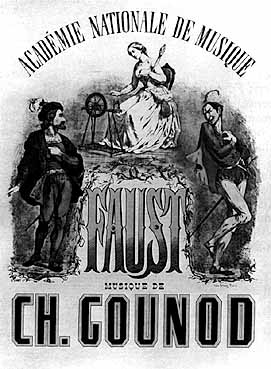
Affiche pour la 500e lithographie de Auguste Lamy Bibliothèque-Musée de l'Opéra http://www.charles-gounod.com/
I've finally given up to the outrageously expensive tickets for the Orange Summer Festival. And will attend one performance of Gounod's Faust. My regular reading of several blogs sure had a great influence on this decision, as well as a friend constantly telling me the acoustics there, alongside the size of the audience is actually an amazing experience in itself. The blogs had an impact on the cast, since I tend to trust more people I can have a general sense of their taste (as well as beloved Le Monde's writer Renaud Machart, of course). Supposedly, the recent performances of Alagna in the MET's Aïda were great. Plus, he always has been a great Faust, at least until 2005.

This one always chats about how fantastic René Pape is, and since he almost exclusively sings Wagnerian operas, Faust is indeed one of the only occasions I truly have to appreciate his singing (of course he'll have to master the very difficult part of Méphistophélès first with special care to the beginning of the church scene in act IV, if it's not too much to ask).

Inva Mula could make a good, if not great, Marguerite, though I must admit I already prepare for the worst in the marathon that is the famous jewels aria. Nicolas Testé will be a real joy to hear again, even if it's only for a few sentences.

Marie-Nicole Lemieux made a good impression in Paris recently, but then again, the part of Dame Marthe is almost insignificant. I've never actually heard the part of Siebel being sung by a male singer, despite my numerous recordings of this opera, so it should be interesting enough.

The part that really scares me, though, is the one of Valentin. The brother of Marguerite has some amazing arias to sing, specifically "Avant de quitter ces lieux" and "Ecoute moi bien, Marguerite", the aria he dies after. Not even to mention the great "C'est une croix". Valentin is the part I love most in Faust. The baritone singing it must really own the score to make it work, and that's no easy job to master. As a matter of fact, all the Valentins I know range from average to pretty bad. All but Ernest Blanc. Is unknown Jean-François Lapointe up to the challenge? I fear he isn't.

Another fear I have is conductor Michel Plasson. He could alone ruin the whole thing. He is supposedly great at understanding French operas, but I'm sorry, he sucks. He destroyed Les Pêcheurs de Perles, his recording of Gounod's Mireille (scheduled for 2010 in Orange with him, once again) is a must-have only because it's the only decent one available, but it does definitely not showcase Gounod's music at its best.

The staging could be less boring than the average standard in Orange, considering Nicolas Joël, soon to become the new director of the Paris Opera, wouldn't put up a dumm concept knowing everybody is watching him. On the other hand, he could.

Finally a word of advice to those who might want to come and see this Faust this summer. You do not want to be trapped on one of the biggest travelling week-ends of the year, aka forget about the August 2nd performance unless the perspective of spending countless hours stuck in traffic or in crowded train stations is one of those you embrace.

Dec 5, 2007

Orange 2008


Next summer in Orange, Les Chorégies will feature two French operas from the XIXth century; world famous Bizet's Carmen (July 12 and 15) and Gounod's Faust (August 2 and 5). The Carmen cast includes Marcelo Alvarez (Don José), Béatrice Uria-Monzon (Carmen) and impressive French mezzo Karine Deshayes (Mercédès), all conducted, as usual in Orange, by Michel Plasson. Nadine Duffaut will direct the opera, and that's an awful news to me (her staging of last year's Les Pêcheurs de Perles in Avignon was dreadful, to say the least). Faust will feature Roberto Alagna (Faust), René Pape (Méphistophélès), Inva Mula (Marguerite) and sensational French bass Nicolas Testé as Wagner (too bad the part is so small), all under the conducting of Michel Plasson - again. Nicolas Joël will direct this cast, for his last staging before taking over the Paris Opera. French TV channel France 2 will broadcast Faust live, as it did last summer with Orange's production of Il Trovatore, with was successful enough to allow this second broadcast. Also worth noticing, the performance of Fauré's Requiem on July 26 in the Cathédrale Notre Dame d'Orange, to commemorate its 800-year existence. Online booking is available, prices range from €220 to €48 (for Faust and Carmen). Preview for the 2009 Summer: - Traviata with Patrizia Ciofi - Pagliacci and Cavalleria Rusticana with Roberto Alagna and Béatrice Uria-Monzon Preview for the 2010 Summer: Gounod's Mireille, probably once again conducted by Michel Plasson, with Franck Ferrari and Karen Vourc'h (Vincenette).

Official website of Les Chorégies.

Oct 19, 2007

Alagna / Aïda update


Ken Howard/Metropolitan Opera


The MET has just posted the mp3 file of Roberto Alagna singing "Celeste Aïda" on Oct.16.
Here it is ;


Ken Howard/Metropolitan Opera


Oct 16, 2007

"Mistico raggio di luce e fior"

Mystical ray of light and flowers
aria "Celeste Aïda"


Dear New Yorkers,

Please accept all my condolences.

Due to yet other illnesses at the MET, Roberto Alagna will fill in tonight for Marco Berti as Ramadès in Verdi's Aïda, a role he has not sung since last December and his walk-off at La Scala.

Don't forget to bring radishes, tomatoes or really anything you can throw at him.
All out of love, of course.


Oct 1, 2007

Fuck Les Chorégies d'Orange


Seriously.

We have two decent Lyric Summer Festivals in France.

Aix-en-Provence for starters, for lovers of operas I can't stand: Monteverdi, Mozart, Wagner...
Therefore I really don't care that they have a fantastic new concert hall, or about the quality of casts and directors they choose.

So I'm left with Les Chorégies d'Orange.
Stuck, I should say.


OK, the operas they play (two each year) are obviously chosen to seduce mass audiences; Gounod's Faust and Carmen for 2008, Il Trovatore and Puccini's Butterfly this summer; Aïda and Lucia di Lammermoor in 2006 (complete list here).
It's mainstream opera all the way, but that's ok 'cause I'm into Verdi, Gounod, Donizetti...

But enough is enough.
Seriously.

They need to upgrade.
Drastically.


Aïda, 2006, © Grand Angle Orange


The stage direction is as bad as can be expected when there's no stage direction.
The sets are non-existant so the stage is just desperately empty (thank God for the Romans by the way, or else there wouldn't even be a stage).

The costumes are way too conventional and boring.

And then, of course, the conductor chosen each year is either the one that couldn't understand the score any worse or Michel Plasson (not much better).


Let's not forget about the chorus.
Historically, the chorus is made of various chorus from around the country, assembled into a reasonable size chorus for the huge Roman theater they sing in. That's roughly 50 men and 50 women.

Please forget about history.
Some things have to change.
The chorus has to go.
For a professionnal one.

No offense to Avignon, Toulon, Metz or any other remote city they come from.
But with a group of second class singers, chances are when you assemble them together they will suck.
Well, they do.
A lot.


Aïda, 2006, © Grand Angle Orange


And finally the cast.
Can we please stop with Roberto Alagna?
Seriously?

He's there every single year (2007 for Manrico in Il Trovatore, 2006 for Ramadès in Aïda, 2005 for La Bohème, 2004 for Carmen...).
I get it that he's the only opera singer French people care about (especially since his shitty tribute album to Luis Mariano). But he's just the ghost of the great tenor he used to be.
And you know what? I don't pitty him a bit.
He should have worked instead of going to every single bullshit TV program he was invited to, destroying all kinds of songs (examples on YouTube here and there).
Plus, I don't forgive him for the Scala incident. This guy has no respect whatsoever for the public, he's way too egomaniac.

I might sound harsh, but seriously people.
Les Chorégies d'Orange suck.


For a budget of about €450.000 for two productions each year, we should have other singers than Alagna, a world-class conductor, a decent chorus and a spectacular staging.

We have none of that.
The French system really sucks, sometimes.


Further readings:
Photos of the past productions here, history of the festival here (also in English here).

YouTube extracts (please enjoy the costumes, stage direction and the work of the conductor):


Aug 15, 2007

Villazon out, Alagna in

So Rolando is really sick... He just pulled out of the first two performances (Sept.25 & 29) of the upcoming MET's production of Gounod's Roméo and Juliette. He will be replaced by Roberto Alagna, whose recent Manrico in Orange was controversial (that I have yet to watch).
Youtube extracts of the Trovatore production in Orange (July 31):
"Ah! sì, ben mio" ; "Di quella pira".

Mar 14, 2007

Elsewhere


” Apparently, our favorite bel canto diva, Anna Netrebko, is gracing the March issue of American Vogue once again. According to the fashion bible, Ms. Netrebko is this century's greatest soprano. What?!!!! Excuse me, while I vomit.
Extract from there.

I love it!


Also, you can find here some pictures of the Massenet’s Manon at the Vienna State Opera, featuring Netrebko and Alagna, directed by Andrei Serban whose controversial Lucia opened the 2006-2007 season in Paris (with Natalie Dessay as Lucia). The Manon performances are conducted by Bertrand De Billy. Two more dates: March 16 and 19.

YouTube extracts are already available here (“Ah fuyez douce image” by Le Chevalier Des Grieux, aka Alagna), there (“En fermant les yeux”, duet between Des Grieux and Manon, aka Netrebko) and there (beginning of the first act, Des Grieux and Manon; Netrebko wearing not much is a joy to see, especially when she’s not singing).


Also, the MET is selling $100,000 tickets for its opening night next September with Natalie Dessay’s Lucia.
Yes $100,000, this is not a mistake.
For that price, the buyer doesn’t even get to spend the rest of the evening on a one on one with Dessay.
Alas, what’s the use?


Photo © Johan Jacobs


Also, March 9 saw the world premiere in Brussels of the first opera of Benoît Mernier, Frühlings Erwachen, based on the play by Frank Wedekind (1890).

Martine D. Mergeay’s review in La Libre Belgique is enthusiastic about everything she heard and saw during that evening (except for the first part of Act I she found annoying).
Some pictures of the production can be found here, along with the synopsis, and the cast.

The opera will be broadcast on Klara Radio on March.24 at 8pm (Paris time) and on Musiq'3 on April 1 at 8pm (Paris time).


Also, if you want to see Angela Gheorghiu singing a Romanian pop song (!) à la Céline Dion, check out this YouTube video.
And then, you can kill yourself after seeing the husband singing on Prime Time French TV La quête, from L’homme de la mancha, with Lara Fabian.

Seriously, how stupid can the couple Gheorghiu / Alagna get?


Mar 13, 2007

La donna è mobile


There are very few operas that have such an effect on me ; wherever I am, as soon as I listen to a few notes from Verdi’s Rigoletto, it’s as if my world stopped, and I have to do nothing else but listen to the music, as long as it goes on.


Sunday evening, as I was programming my Hi-Fi system for my Monday morning wake up, I discovered that this week’s opera broadcast of Radio Classique was indeed Rigoletto (since, for no apparent reason, Radio Classique seems unwilling to share this kind of info at the moment, either on its site or on Operacast).


So naturally I rushed into my armchair and didn’t get up until the opera was over.


The version I got to listen was the famous Kubelik’s recording from La Scala, with a cast that can only make your head spin;


Rigoletto: Carlo Bergonzi
Il duca di Mantova : Dietrich Fischer-Dieskau
Gilda: Renata Scotto
Sparafucile : Ivo Vinco
Maddalena : Fiorenza Cossotto
Il Conte di Monterone : Lorenzo Testi


This recording is believed to be, by many, the best Rigoletto you’ll ever find.
Not everybody agrees with that statement, though.
I certainly don’t.

And the main reason is that, however great the singers might be, the success of a version over another mostly lies with the conductor.


People too often underestimate the role of this buffoon gesticulating in front of the orchestra with awkward movements and a baton that seems to enhance his craziness.


Yet, a bad orchestration can ruin any fantastic performance a singer can have.

It certainly can prevent me from listening to some recordings; take the Giulini’s Traviata featuring Maria Callas for instance ; or the Plasson’s Pêcheurs de Perles.


Well, the Kubelik’s Rigoletto rather falls in that category; too slow, too heavy, too rigid, not Italian enough. Not a great performance from the conductor, for sure.
Especially if you compare it with the recording Riccardo Muti made in the mid 90s (live performance from La Scala).


That’s why the perfect recording is almost impossible to get; the conductor has to be perfect, the orchestra, the chorus, all the cast members… and I’m not even talking about a performance on stage, where you can add the director, the dramaturge, the choreographer, the setting director, the costume design director, the lighting director, the make-up artist…


YouTube extracts from Muti’s Rigoletto ;
NB. Notice how Roberto Alagna was young and thin, then


- « Questa o quella » (Act I, sc1) Il duca di Mantova
- « Addio, addio, speranza ed anima » (Act I sc.12) duet Gilda / Il duca di Mantova
- « Caro nome » (Act I sc.14) Gilda / Coro
- « Ella mi fu rapita! » (Act II sc.1) Il duca di Mantova
- « Ei vien! Silenzio! » (Act II sc.3) Coro / Il duca/Rigoletto
- « Ciel! Damni corragio! » (Act II sc.6) duet Gilda / Rigoletto
- « La donna è mobile » (Act III) Il duca di Mantova
- end of the opera (Act III) duet Rigoletto / Gilda

Mar 10, 2007

Faust, Gounod


A l’occasion de la sortie, dans le Monde de ce samedi, du Faust de Gounod, un de mes opéras favoris ;


Charles Gounod


Créé en 1859, Faust a été traduit en 34 langues dans 45 pays et fête sa millième représentation dès 1894 (2000e en 1934); il fait l’inauguration du Metropolitan Opera de New York en 1883, et y est repris en ce moment, avec une retransmission en direct samedi prochain 17 mars à 18h30 (avec Ramon Vargas dans le rôle de Faust).


Projet présenté à l’Opéra de Paris (et refusé) en 1856, Léon Carvalho, directeur du Théâtre Lyrique accepte l’œuvre, puis se rétracte, pour finalement revenir sur sa décision en 1859.


Le livret, d’après le Premier Faust de Goethe, est commandé en 1856 par Gounod au duo Michel Carré / Jules Barbier, après qu’il ait été conquis par la pièce de Michel Carré, Faust et Marguerite, centrée autour de l’intrigue amoureuse et du sort de Marguerite.


La partition à peine achevée, en septembre 1858, les répétitions commencent au théâtre de la Porte Saint-Martin, avec Marie Miolhan-Carvalho dans le rôle de Marguerite (l’épouse de Léon Carvalho, qui obtint le rôle à la demande expresse de son mari mais qui visiblement campa une Marguerite remarquable), Emile Balanqué en Méphistophélès et Hector Gruyer, « Guardi » en Faust, dont la prestation en répétitions ravit Gounod mais dont la voix s’effondre le jour de la générale (causant le report de la première) et qui est écarté (d’aucuns devraient s’en inspirer) et remplacé par le provençal Joseph-Théodore-Désiré Barbot, élève de François Desarte, qui apprend le rôle monumental en à peine trois semaines, dont la prestation impressionne Bizet (qui considérait l’opéra maudit après les mésaventures de Gruyer) et Berlioz.
Siebel est créée par Melle Faivre, alors que Valentin est chanté par Raynal.


L’opéra connaît un succès mitigé après la première le 19 mars 1859, du fait de sa rupture avec la tradition du Grand Opéra.


La vente de la partition et des morceaux détachés, le jugement de musiciens éclairés (Berlioz, Bizet, Debussy, Busoni ou Stravinsky) et le succès de Roméo et Juliette et Mireille concourent au triomphe en 1869 (version révisée en supprimant les parties parlées entre les airs, présentes dans la partition originale, par des récitatifs ; à laquelle Gounod ajouta de plus les ballets ouvrant l’acte V), lors du retour sur la scène de l’Opéra.
La 500e a lieu dès 1886, sous la direction de Gounod lui-même.


Comment ne pas rendre grâce aux qualités musicales indéniables de la partition, au premier lieu desquelles une richissime écriture vocale, avec cinq personnages principaux balayant toutes les tessitures : Faust, ténor ; Marguerite, soprano colature ; Méphistophélès, basse ; Valentin, le frère de Marguerite, baryton ; et Siebel, mezzo, s’inscrivant dans la tradition française des travestis ?


Tous les autres ingrédients d’un grand succès sont présents dans la partition de Gounod ; une orchestration raffinée, des chœurs énergiques (« Vin ou bière » à l’acte II, « Gloire immortelle de nos aïeux » à l’acte V …), une incroyable richesse mélodique (divine cavatine de Valentin à l’acte II « Avant de quitter ces lieux » ; première rencontre entre Faust et Marguerite à la fin de l’acte II « Ne permettrez vous pas » ; air de Faust à l’acte III « Salut ! Demeure chaste et pure » ; airs de Marguerite « Il était un roi de Thulé » et le célébrissime air des bijoux à l’acte III, duo Faust/Marguerite « O nuit d’amour, ciel radieux » toujours à l’acte III ; sérénade de Méphistophélès à l’acte IV « Vous qui faites l’endormie », duo final entre Faust et Marguerite « Oui, c’est toi, je t’aime » …), des scènes de ballet (début de l’acte V), et des scènes intimes (« J’ai languis, triste et solitaire » de Faust, ouvrant l’opéra ; scènes de Marguerite à l’acte III …) rompant définitivement avec le Grand Opéra à la Française, dont La Juive (Gounod a été l’élève d’Halévy au conservatoire).


La partition a néanmoins été passablement modifiée avant la première, à la demande de Carvalho qui exigea notamment que Gounod supprime l’air de Valentin « Chaque jour nouvelle affaire » à l’acte IV, remplacé par le chœur « Gloire immortelle » que Gounod récupéra d’un opéra inachevé, Ivan le Terrible ; de même, la fameuse scène de l’église fut déplacée à la fin de l’acte IV (et supprimée lors de la première à la demande du Ministre des Beaux-Arts pour éviter toute tension avec le Vatican, dans le contexte politique houleux de l’époque).


La version présentée par le Monde ce samedi est un enregistrement live de 1973 (remastérisé par la NHK en 2007) d’une très bonne facture (à part Lorenzo Saccomani dans le rôle de Valentin, mais comment soutenir la comparaison avec Ernest Blanc en même temps), avec une mention particulière à l’orchestration de Paul Ethuin et à la prestation remarquable d’Alfredo Kraus.

Faust : Alfredo Kraus
Marguerite : Renata Scotto
Méphistophélès: Nicolaï Ghiaurov
Valentin: Lorenzo Saccomani
Siebel : Milena Dal Piva
Marthe : Anna Di Stasio
Wagner: Guido Mazzini
Chœurs et orchestre de la NHK de Tokyo
Direction : Paul Ethuin

Extrait Youtube de cette version:
Final de l'acte V


Version indispensable :


EMI Classics, 1959 version
Faust: Nicolai Gedda
Marguerite: Victoria De Los Angeles
Méphistophélès: Boris Christoff
Valentin: Ernest Blanc
Siebel : Liliane Berton
Marthe : Rita Gorr
Wagner : Victor Autran
Chœurs et orchestre du Théâtre National de l’Opéra
Direction : André Cluytens


Post réalisé à partir des textes parus dans les versions CD ci-dessus ainsi que dans le Monde 2 (p62) de ce jour et dans le livret du DVD de 1985 du Vienna State Opera dirigée par Erich Binder.


Extraits choisis de Youtube :

- scène de l'église avec Marguerite (Angela Gheorgiu) et Méphistophélès (Bryn Terfel) dans la version 2004 du Covent Garden (direction Antonio Pappano)
- « laisse ta main s’oublier dans la mienne », duo entre Marguerite (Angela Gheorghiu) et Faust (Roberto Alagna) dans la même version
- toujours dans la version de Covent Garden, extrait de l’acte I, « A moi les plaisirs », Faust et Méphistophélès

- mort de Valentin (fin de l’acte IV), dans la production de décembre 2006 à Come et Modène (Italie) avec Javier Franco (Valentin), dirigée par Philippe Auguin
- « avant de quitter ces lieux » air de Valentin (acte I) par Simon Keenlyside dans la production de 2004 du Covent Garden