Showing posts with label gheorghiu. Show all posts

Jan 11, 2009

Rondine from the Met


La Rondine 
Giacomo Puccini
Opera in 3 acts
Libretto Giuseppe Adami
Premiere Théâtre de Monte Carlo, March 27 1917

Magda: Angela Gheorghiu
Lisette: Lisette Oropesa
Ruggero: Roberto Alagna
Prunier: Marius Brenciu
Rambaldo: James Courtney

Conductor: Marco Armiliato
Production: Nicolas Joël
Set Designer: Ezio Frigerio
Costume Designer: Franca Squarciapino
Lighting Designer: Duane Schuler

Premiere in Toulouse in March 2005, performed in San Francisco in Nov. 2008
Jan.10 Arte broadcast live from the Met

Synopsis here and there, libretto (Italian only) here

 
Act 1, Terrence McCarthy
 
Act 2, Terrence McCarthy

 
Not much to say about this production of Nicolas Joël, except for the obvious word that comes to mind: boring. The set, the costumes, the lights, the actors' direction, everything is very very forgettable.

His dollhouse version of La Rondine lacks any kind of statement, exploration of characters, work on the relationships between the characters, any kind of analysis really. As for the muscial performance, Marco Armiliato's reading of the score is also especially boring, as it lacks passion, emotions and life (so basically, he missed the whole point of the score there).


The cast was also pretty forgettable; Gheorghiu was out of breath from the start, displayed no real emotion and struggled with her voice all evening; Marius Brenciu' singing was inexpressive as well and his high notes were not particularly successful; James Courtney's use of vibrato was excessive; Lisette Oropesa's Lisette was energetic and full of life, but her diction was well, lost from the beginning.

The only one that stood out for me was Roberto Alagna. His diction is so refined he's the only one I know who can sing perfectly such lines as "Cosi timida e sola assomigliate alle ragazze di Montauban" (Act 2) with the perfect pronunciation, both in Italian and in French on "Montauban". His expressivity could have been better, but it was so much better than the rest of the cast, it felt like he was the only one really trying to portray his character. A rather disappointing evening.

Mar 5, 2008

2008-09 at the Met


The 125th season at the Met will open on Sept.22, 2008 with a gala performance from Renée Fleming (extracts from Massenet's Manon, La Traviata and Strauss' Capriccio) and will feature 6 new productions (including the Met premiere of John Adams' Doctor Atomic).

Amongst the new productions, Berlioz's La damnation de Faust is an interesting attempt to make this opera available to everyone. This Robert Lepage's production was first created for the Saito Kinen Festival in Matsumoto (Japan) in september 1999 and already traveled to Paris (Opéra Bastille in 2001 and 2004) and Bruxelles (Théâtre de la Monnaie, 2002).


Massenet's Thaïs should be a great opportunity for Renée Fleming to shine.

Another new production will be Puccini's La Rondine, by future Paris Opera director Nicolas Joël, with Duane Schuler as lightning designer (a very recurrent artist here in Lyon). Angela Gheorghiu and Roberto Alagna are supposed to share the stage. I hope Peter Gelb has already thought of alternative names for when they cancel (say, three days before the premiere).

David McVicar's new production of Il Trovatore should have New Yorkers all excited, although the cast seems a little weak (except for Dmitri Hvorostovsky of course).

Finally, last but not least, a new production of Bellini's La Sonnambula will feature the well-known couple Natalie Dessay/Evelino Pidó (who performed this piece in Lyon in Nov.2006, my reviews in French here and there, with a recording by Virgin Classics) with the notable addition of Juan Diego Flórez, in the Ricordi edition recently rediscovered.


The oldies are back with Zeffirelli's production of La Bohème and Cavalleria Rusticana (Roberto Alagna and José Cura will share the role of Turiddu, with Andrea Gruber as Santuzza, a much better cast than last year's performers) and Pagliacci (Alagna/Cura as well as Canio), and finally with La Traviata (enough with Zeffirelli already).

Interesting cast in Donizetti's L'elisir d'amore (Gheorghiu, Villazón/Calleja, Terfel), Eugene Onegin (Mattila, Hampson).

Finally, I want to point out the return of fantastic Ewa Podles as La Cieca in Poncielli's La Gioconda (dream cast indeed with Deborah Voigt as Gioconda, Aquiles Machado as Enzo and Olga Borodina as Laura).


Feb 1, 2008

Hospital noticeboard in France too


The pandemic amongst opera singers is indeed worldwide. After recent cancellations by JDF (Kansas City & Chicago), Dmitri Hvorostovsky (London), Anna Netrebko (London) and Andreas Scholl (also London), Angela Gheorghiu has canceled her upcoming recital in Paris (Salle Pleyel). Tickets will be reimbursed, as no alternative date could be found.

Sep 29, 2007

Gheorghiu fired from Chicago


Just three days before the Chicago premiere of Puccini's La Boheme, Angela Gheorghiu was let go by the Lyric Opera.
Said general director William Mason, "Miss Gheorghiu has missed six of 10 rehearsals, including the piano dress rehearsal and both staging rehearsals with the orchestra," Mason said. "She missed one of the most critical stage-orchestra rehearsals when she left the city for New York without permission, a direct violation of her contract."
"It is with tremendous regret and sadness that we are compelled to take this action," he added, "but Miss Gheorghiu's actions have shown total disregard for Lyric Opera's dedicated personnel and for her fellow artists."
The complete story is reported by the Chicago Tribune here and by AP here.
How disappointed one of her biggest fans must be...

Mar 27, 2007

Hiatus

One thing I love about opera is that nobody ever agrees on anything. Take the recent performance of Angela Gheorghiu in Verdi's Traviata at the MET. Yesterday, I was reading this enthusiastic post. Today, the opposite;
" Gheorghiu's Violetta was, in its low key, medium voiced way, effective, but I felt there was something "patented" about it - emotions taken "out of the box" intact for this performance and then put back in, likewise intact, for the next outing.
The curtain calls were ridiculous and showed what might have been really going on in our Leading Lady's mind - all sorts of superannuated "little girl" scamperings, skippings, wavings etc.the public's Indulged Darling "in excelcis."
By the ovations she got you would have thought this woman combined the technical prowess of Sutherland (NOT!) with the interpretative genius of Callas (most definitely NOT!).
Maybe I've seen too much that has moved me as being genuine (as recently as Die Agyptische Helena on Friday and Banks, Vlasak-Nolen in La Donna del Lago on Saturday) to have responded to this kind of ersatz art. "
Stephen Charitan

Mar 24, 2007

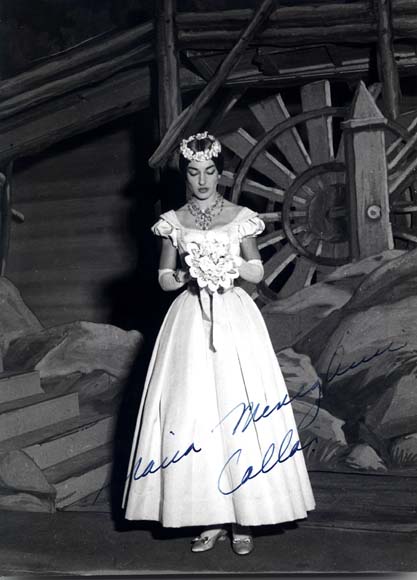
[Ears openers] III. Maria Callas


Everything has already been said and written about La Callas.
So I’m not gonna add another enthusiastic post from another unconditional fan.


I just wanted to let you be the judge.
I’ve selected 4 extracts from YouTube, from the 4 major female roles in Italian opera; Amina in Bellini’s La Sonnambula, Lucia from Donizetti’s Lucia di Lammermoor, Norma from Bellini’s Norma and Violetta from Verdi’s La Traviata.


I’m giving you the YouTube version of Maria Callas I prefer, as well as the other version I fancy (from anyone but Callas).

There’s no brainstorming on these extracts for me.
However great the other singer is (and I must admit Ciofi as Lucia, Gheorghiu as Violetta and Dessay as Amina are pretty amazing), Maria Callas is still singing in another galaxy.


Amina – La Sonnambula – two extracts from two recitals of the same aria, “Ah! non credea mirarti”
The Callas recital, the 2006 New York performance of Natalie Dessay.


Lucia – Lucia di Lammermoor – two live performances of the Mad Scene.
The Callas 1955 live from Berlin (part one, part two), the 2006 Orange performance of Patrizia Ciofi (part one, part two).


Norma – Norma – two live performances of “Casta Diva”
The Callas 1955 Opening night at La Scala (sound only), the 1974 Orange performance of Montserrat Caballé.


Violetta – La Traviata – two live performances of “Sempre libera”
The Callas 1951 live from Mexico City (sound only), the 1994 Covent Garden performance of Angela Gheorghiu.


Further readings

- An article published in Time Magazine on Callas, written by Cecilia Bartoli
- Interviews of Maria Callas in French (1965 and 1969), extracts from the INA archives (other extracts here)

- French site exclusively about Maria Callas
- La Divina Maria Callas (in Italian and in English)
- listing of main sites about Callas


Mar 14, 2007

Elsewhere


” Apparently, our favorite bel canto diva, Anna Netrebko, is gracing the March issue of American Vogue once again. According to the fashion bible, Ms. Netrebko is this century's greatest soprano. What?!!!! Excuse me, while I vomit.
Extract from there.

I love it!


Also, you can find here some pictures of the Massenet’s Manon at the Vienna State Opera, featuring Netrebko and Alagna, directed by Andrei Serban whose controversial Lucia opened the 2006-2007 season in Paris (with Natalie Dessay as Lucia). The Manon performances are conducted by Bertrand De Billy. Two more dates: March 16 and 19.

YouTube extracts are already available here (“Ah fuyez douce image” by Le Chevalier Des Grieux, aka Alagna), there (“En fermant les yeux”, duet between Des Grieux and Manon, aka Netrebko) and there (beginning of the first act, Des Grieux and Manon; Netrebko wearing not much is a joy to see, especially when she’s not singing).


Also, the MET is selling $100,000 tickets for its opening night next September with Natalie Dessay’s Lucia.
Yes $100,000, this is not a mistake.
For that price, the buyer doesn’t even get to spend the rest of the evening on a one on one with Dessay.
Alas, what’s the use?


Photo © Johan Jacobs


Also, March 9 saw the world premiere in Brussels of the first opera of Benoît Mernier, Frühlings Erwachen, based on the play by Frank Wedekind (1890).

Martine D. Mergeay’s review in La Libre Belgique is enthusiastic about everything she heard and saw during that evening (except for the first part of Act I she found annoying).
Some pictures of the production can be found here, along with the synopsis, and the cast.

The opera will be broadcast on Klara Radio on March.24 at 8pm (Paris time) and on Musiq'3 on April 1 at 8pm (Paris time).


Also, if you want to see Angela Gheorghiu singing a Romanian pop song (!) à la Céline Dion, check out this YouTube video.
And then, you can kill yourself after seeing the husband singing on Prime Time French TV La quête, from L’homme de la mancha, with Lara Fabian.

Seriously, how stupid can the couple Gheorghiu / Alagna get?


Mar 10, 2007

Faust, Gounod


A l’occasion de la sortie, dans le Monde de ce samedi, du Faust de Gounod, un de mes opéras favoris ;


Charles Gounod


Créé en 1859, Faust a été traduit en 34 langues dans 45 pays et fête sa millième représentation dès 1894 (2000e en 1934); il fait l’inauguration du Metropolitan Opera de New York en 1883, et y est repris en ce moment, avec une retransmission en direct samedi prochain 17 mars à 18h30 (avec Ramon Vargas dans le rôle de Faust).


Projet présenté à l’Opéra de Paris (et refusé) en 1856, Léon Carvalho, directeur du Théâtre Lyrique accepte l’œuvre, puis se rétracte, pour finalement revenir sur sa décision en 1859.


Le livret, d’après le Premier Faust de Goethe, est commandé en 1856 par Gounod au duo Michel Carré / Jules Barbier, après qu’il ait été conquis par la pièce de Michel Carré, Faust et Marguerite, centrée autour de l’intrigue amoureuse et du sort de Marguerite.


La partition à peine achevée, en septembre 1858, les répétitions commencent au théâtre de la Porte Saint-Martin, avec Marie Miolhan-Carvalho dans le rôle de Marguerite (l’épouse de Léon Carvalho, qui obtint le rôle à la demande expresse de son mari mais qui visiblement campa une Marguerite remarquable), Emile Balanqué en Méphistophélès et Hector Gruyer, « Guardi » en Faust, dont la prestation en répétitions ravit Gounod mais dont la voix s’effondre le jour de la générale (causant le report de la première) et qui est écarté (d’aucuns devraient s’en inspirer) et remplacé par le provençal Joseph-Théodore-Désiré Barbot, élève de François Desarte, qui apprend le rôle monumental en à peine trois semaines, dont la prestation impressionne Bizet (qui considérait l’opéra maudit après les mésaventures de Gruyer) et Berlioz.
Siebel est créée par Melle Faivre, alors que Valentin est chanté par Raynal.


L’opéra connaît un succès mitigé après la première le 19 mars 1859, du fait de sa rupture avec la tradition du Grand Opéra.


La vente de la partition et des morceaux détachés, le jugement de musiciens éclairés (Berlioz, Bizet, Debussy, Busoni ou Stravinsky) et le succès de Roméo et Juliette et Mireille concourent au triomphe en 1869 (version révisée en supprimant les parties parlées entre les airs, présentes dans la partition originale, par des récitatifs ; à laquelle Gounod ajouta de plus les ballets ouvrant l’acte V), lors du retour sur la scène de l’Opéra.
La 500e a lieu dès 1886, sous la direction de Gounod lui-même.


Comment ne pas rendre grâce aux qualités musicales indéniables de la partition, au premier lieu desquelles une richissime écriture vocale, avec cinq personnages principaux balayant toutes les tessitures : Faust, ténor ; Marguerite, soprano colature ; Méphistophélès, basse ; Valentin, le frère de Marguerite, baryton ; et Siebel, mezzo, s’inscrivant dans la tradition française des travestis ?


Tous les autres ingrédients d’un grand succès sont présents dans la partition de Gounod ; une orchestration raffinée, des chœurs énergiques (« Vin ou bière » à l’acte II, « Gloire immortelle de nos aïeux » à l’acte V …), une incroyable richesse mélodique (divine cavatine de Valentin à l’acte II « Avant de quitter ces lieux » ; première rencontre entre Faust et Marguerite à la fin de l’acte II « Ne permettrez vous pas » ; air de Faust à l’acte III « Salut ! Demeure chaste et pure » ; airs de Marguerite « Il était un roi de Thulé » et le célébrissime air des bijoux à l’acte III, duo Faust/Marguerite « O nuit d’amour, ciel radieux » toujours à l’acte III ; sérénade de Méphistophélès à l’acte IV « Vous qui faites l’endormie », duo final entre Faust et Marguerite « Oui, c’est toi, je t’aime » …), des scènes de ballet (début de l’acte V), et des scènes intimes (« J’ai languis, triste et solitaire » de Faust, ouvrant l’opéra ; scènes de Marguerite à l’acte III …) rompant définitivement avec le Grand Opéra à la Française, dont La Juive (Gounod a été l’élève d’Halévy au conservatoire).


La partition a néanmoins été passablement modifiée avant la première, à la demande de Carvalho qui exigea notamment que Gounod supprime l’air de Valentin « Chaque jour nouvelle affaire » à l’acte IV, remplacé par le chœur « Gloire immortelle » que Gounod récupéra d’un opéra inachevé, Ivan le Terrible ; de même, la fameuse scène de l’église fut déplacée à la fin de l’acte IV (et supprimée lors de la première à la demande du Ministre des Beaux-Arts pour éviter toute tension avec le Vatican, dans le contexte politique houleux de l’époque).


La version présentée par le Monde ce samedi est un enregistrement live de 1973 (remastérisé par la NHK en 2007) d’une très bonne facture (à part Lorenzo Saccomani dans le rôle de Valentin, mais comment soutenir la comparaison avec Ernest Blanc en même temps), avec une mention particulière à l’orchestration de Paul Ethuin et à la prestation remarquable d’Alfredo Kraus.

Faust : Alfredo Kraus
Marguerite : Renata Scotto
Méphistophélès: Nicolaï Ghiaurov
Valentin: Lorenzo Saccomani
Siebel : Milena Dal Piva
Marthe : Anna Di Stasio
Wagner: Guido Mazzini
Chœurs et orchestre de la NHK de Tokyo
Direction : Paul Ethuin

Extrait Youtube de cette version:
Final de l'acte V


Version indispensable :


EMI Classics, 1959 version
Faust: Nicolai Gedda
Marguerite: Victoria De Los Angeles
Méphistophélès: Boris Christoff
Valentin: Ernest Blanc
Siebel : Liliane Berton
Marthe : Rita Gorr
Wagner : Victor Autran
Chœurs et orchestre du Théâtre National de l’Opéra
Direction : André Cluytens


Post réalisé à partir des textes parus dans les versions CD ci-dessus ainsi que dans le Monde 2 (p62) de ce jour et dans le livret du DVD de 1985 du Vienna State Opera dirigée par Erich Binder.


Extraits choisis de Youtube :

- scène de l'église avec Marguerite (Angela Gheorgiu) et Méphistophélès (Bryn Terfel) dans la version 2004 du Covent Garden (direction Antonio Pappano)
- « laisse ta main s’oublier dans la mienne », duo entre Marguerite (Angela Gheorghiu) et Faust (Roberto Alagna) dans la même version
- toujours dans la version de Covent Garden, extrait de l’acte I, « A moi les plaisirs », Faust et Méphistophélès

- mort de Valentin (fin de l’acte IV), dans la production de décembre 2006 à Come et Modène (Italie) avec Javier Franco (Valentin), dirigée par Philippe Auguin
- « avant de quitter ces lieux » air de Valentin (acte I) par Simon Keenlyside dans la production de 2004 du Covent Garden


Dec 18, 2006

"A pain in the aria"

I strongly suggest you read the following article from the Sydney Morning Herald, about Alagna and Gheorghiu, so true and with some pretty sarcastic images I love (starting with the title).

Chosen extracts; "The careers of Alagna and Gheorghiu rocketed a decade ago. He was the hottest young tenor around, the destined successor to the Pavarotti-Domingo-Carreras generation, and was duly dubbed "the fourth tenor". She took the operatic world by storm in La Traviata under the late Georg Solti at Covent Garden in 1994 and seemed to be the lyric soprano the world had waited for since Sutherland's retirement. When the two married, they became the darlings of the opera houses, the record companies, opera-goers and the accountants. But they were rarely the darlings of the directors."

"Alagna's walkout from La Scala comes at a time when a lot of the glister has gone from the one-time golden couple. The previous Scala regime under Riccardo Muti fell out with Gheorghiu as early as 1997. The New York Met's recently retired general director, Joe Volpe, had a bust-up with her. Now it seems the soprano has fallen out with Covent Garden. Rumours that she was dropped from a coming production of Verdi's Don Carlos - because music director Antonio Pappano was so angered by her failure to turn up for rehearsals at this year's Tosca that he has declined to work with her again - have met flat denials. Covent Garden insists Gheorghiu decided to withdraw."

"Opera houses usually try to stop stories of demanding behaviour getting into the press. But the veil was lifted when Volpe fired the soprano Kathleen Battle from the Met in 1994, publicly citing her "unprofessional actions". (...) Battle's manager reminded Volpe that his predecessor was always known as the man who had fired Callas from the Met. Do you want to be known as the man who fired Battle, he demanded? Volpe had the perfect reply: "Kathy Battle is no Maria Callas.""

Thank you Martin Kettle. Very good article. And without drama. What a relief.