Showing posts with label glass. Show all posts

Feb 14, 2009

The cost of composing an opera


Interesting article in Le Monde today about the creation of a new opera, "Avec Philippe Boesmans, dans les secrets d'un opéra nouveau".

According to Gérard Mortier, the most paid composer these days is Philip Glass (no surprise there), whose salary could compare to the one Laurent Pelly received for his Fille du Régiment, "Le mieux payé aujourd'hui est Philip Glass qui reçoit à peu près ce qui est versé à un metteur en scène connu pour un opéra coproduit par trois maisons. Au prorata du temps passé, un compositeur reste donc beaucoup plus mal payé qu'un chef d'orchestre ou un metteur en scène...".

Another interesting fact is that 70-year period after a composer's death where you are required to pay royalties to his heirs, meaning for instance playing any Richard Strauss' opera (he died in 1949) costs as much as any performance of Glass or any other composer still alive.

Feb 1, 2009

Young Glass


Metropolitan Opera
April 25, 2008

New Glass in town


In the penal colony
chamber opera by Philip Glass (Seattle 2000)
libretto Rudolph Wurlitzer from Kafka's In the penal colony, available here.

Stephen Owen - the officer
Stefano Ferrari - the visitor
Mathieu Morin - the convict (non singing part)

Philippe Forget, musical direction
Richard Brunel, staging

Quintette à cordes des musiciens de l'opéra de Lyon

Opéra de Lyon hors les murs
Studio Lumière 2, Villeurbanne

January 31, 2009
French premiere new prodution


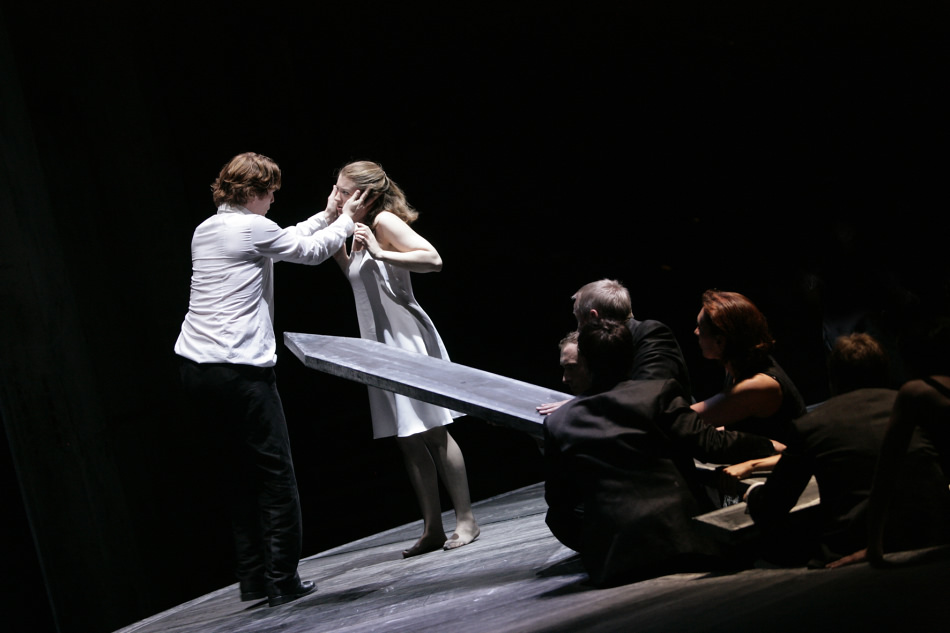
Written for two singers (a baritone and a tenor), one speaking actor (the convict) and 2 non-speaking ones, In the penal colony lasts 80 minutes and is played by a string quintet (two violins, one alto, one cello and one double bass). The libretto, very close to Kafka's original words, is divided into 16 shorts scenes plus one epilogue. In an island converted into a surrealist prison, we follow the last 12 hours of a convict before his execution by the Harrow which inscribes his offense on his body with multiple needles.

The score Philip Glass composed is a well-balanced act that alternates between contemplative sections and very dramatic ones, complementing the story perfectly.

As for this French premiere run, it was originally scheduled at a real prison, but the suicide rate among convicts in France is so high at the moment the competent authorities thought it would be a bit too controversial to have this pamphlet in their own dirty backyard.
So instead, the Opéra de Lyon chose the Studio Lumière 2 (named after the world famous two lyonnais brothers) somewhere far far away from the city center, in a gloomy area (especially at night) perfect in the context.
The seats on the other hand could have been changed into something actually comfortable.


Mathieu Morin (left) as the convict (non singing role) was phenomenal, simply put. He really was the focus point on stage at all times, and his breathing was mesmorizing.

The two others non-singing roles, Gérald Robert-Tissot and Nicolas Hénault were clearly not on the same level, as their acting was relatively uninspired.


The staging of Richard Brunel, though filled with small good ideas (the musicians dressed as judges during the first scene especially), was overall radiating amateurism, and reminded me of my college years, when we used to have DIY productions with little money but "big" ideas. Coming from the Opéra de Lyon, I find this to be stingy at best. The conceptualization of the Harrow was especially clumsy and distractive.


I also question the will of the director to place the musicians on stage, because someone like me ends up spending half of the performance (maybe more) watching them instead of watching the actual action.

I reckon I was probably the only one doing that so extensively, but still. I was a bit afraid when I heard some not so perfect notes from alto Donald O'Neil in the first 20 bars or so, but the overall performance of the 5 musicians was no less than amazing.

They played with poise, finesse, sensibility, nuances and perfect unison, and all that without a conductor on stage. Some notes of the double bass were doubtful, but really, fantastic job from Nicolas Gourbeix (first violin of the Orchestra of the Opéra de Lyon), Karol Miczka, Donald O'Neil, Jean-Marc Weibel and Cédric Cartier.


Stephen Owen (left) as the officer was also a sensation. His low notes were superb and his expressivity perfectly dosed. His acting skills are a bit limited, but his singing is clearly not.

Stefano Ferrari (the visitor) was less successful; he tried to mask the weakness of his high notes with a bigger sound and it did not work. He also had issues projecting his voice: in this small hall (200/300 people), he sang too loudly and without the proper restraint. His middle and lower register were fine, but he also overdid it with regards to his expressivity: then again not enough restraint, that sometimes led to ridicule.


All and all, if you have strong affinities (like myself) with Philip Glass, this was a great evening.

As I've already mentioned, Lyon is indeed a city in love with Philip Glass, and this run is sold out, even with the extra performance added to the schedule (Jan.27). Last two performances on Monday (Feb.2) and Wednesday (Feb.4).
Extra performance in Nîmes on March 4.  


All pictures (except the first two) from the Opéra de Lyon

Jan 28, 2009

Minimalist cocktail

What a great combination: Philip Glass and Muse.


Philip Glass - "Prophecies", Koyaanisqatsi 
Muse - "Take a bow", Black Holes And Revelations Watchmen trailer

Oct 1, 2008

New Glass' operas to come


I wonder why the media widely reported about the new commission of the New York City Opera for The Perfect American, a piece about the late years of Walt Disney and NOT at all about Philip Glass next world premiere - Kepler, scheduled in September 2009 in The Landestheater Linz (Austria). Could it be that the media world is a bit snobbish ? Doesn't it sound like Philip Glass' work is only worth reporting about if it is played in a major Opera House? Anyway, the greatest of news is that The Perfect American will be staged by Improbable. Their work on Satyagraha last spring at the Met (ENO's original production) was clearly a defining moment for me.

May 8, 2008

Wim Mertens


Live at Nieuwe Workshop, Brussels, Belgium, 1981


And yet I had no idea Philip Glass had a child...


Video Clip on YouTube there.
Official website here.

Apr 27, 2008

Satyagraha


This is the most beautiful staging I have ever seen in opera.
An artistic journey through slow-motion[1] perfectly complimented by the music of Philip Glass.
The work of English director Phelim McDermott and his company Improbable brought magic to the stage of the Metropolitan Opera, making it indispensable to pass on a perfect spring saturday afternoon in New York.


End of Act III


This production is enlightened by very aesthetic effects that are accessible, meaningful and poetry, really. The beauty of the visual is what kept me very much in this 3 hours and a half of Glass' music. Not that I don't appreciate his music because I do, a lot, but three hours and a half is really a long time to focus on it. The mind-wandering experience gets annoying after a while (one hour is my usual limit).
Yet I couldn't leave early because of this extraordinary staging. Trying to describe the set and the lightning accurately is no easy task, but these pictures give a good overview and will definitely help me remember this afternoon at the opera.


The cohesion between the music and the staging is exceptional; the slow-motion in particular is a perfect fit for Glass' minimalism.
The puppets[2] everybody talked about can seem a bit over the top but in context, they offer an interesting display of the old battle of David vs. Goliath (especially in the first scene where the English monarchy, portrayed by a praying mantis is fighting against the Indian soldier in armor).


Beginning of Act II, ENO performance


The journey ends visually as it started, Gandhi being buried under newspapers, in the same way Glass' music is always going in circles, which was, once again, a very relevant and thoughtful touch.


The Vow (scene 3 of Act I)
ENO performance


Lightning and staging details

  • various supports are used to project words (English or Sanskrit) in the first scene (newspapers hold vertically by the actors) and then again in Act II (parts of the corrugated-iron walls[3]). The result is probably intended to be powerful and politically inclined (as this whole piece is), it was really just a nice visual effect in my dreamy journey.

  • the Tolstoy scene (scene 2 of Act I) ends with bar branches planted in the floor, dividing the space to show the different routes each character is going through. The tiny cottages brought on stage afterwards bring absolutely nothing to the atmosphere, but the windows opening high in the set walls provided very pictorial yet very meaningful frozen scenes.

Tolstoy Farm, 1910
Scene 2 of Act I


  • the alligator made of weaving baskets in the beginning of The Vow (scene 3 of Act I) did not do it for me; later in that scene, the hangers that descended from the ceiling and where everybody on stage hung his or her jacket were really successful. The gathering around the fire in the middle of the stage later on was well-choreographed and definitely added to the fantasy of the scene.

  • the second act was the least captivating at all, beginning with those strange costumes for the chorus, very different from any over designed for that production, and awkwardly irrelevant.

New Castle March, Act III
ENO performance


  • the last act however was incredibly powerful. The use of duct tape to build walls across the stage was not only visually brilliant, I also can't think of a better way to symbolize the New Castle March.

    At the end of Act III, the set completely opens up, leaving nothing but a very high and thin podium in the center, where an actor, back toward the audience, plays Martin Luther King and silently harangues an imaginary crowd. Some videos of MLK had previously been projected on the walls before they open.
    Not only does this reference make sense and perfectly relate to Gandhi (both being non-violent revolutionary leaders), but the timing couldn't be better, as we recently commemorated the 40th anniversary of Martin Luther King's assassination.


I am pretty sure I wouldn't have survived this Satyagraha experience had it not been for that superb production of Phelim McDermott that premiered last year at the English National Opera and is his first opera direction.
This was indeed a unique and fantastic experience, one of those I will carry with me for many years.


Complete libretto translation:


[1] Although the slow-motion idea worked perfectly, it is also the reason for the only real issue I had with this production: the immobility of the singers when performing, which turned out to be a recurring theme and got rapidly boring
[2] "The struggle of the puppeteers and aerialists to create the large mythical figures would be a reflection of the Satyagraha struggle itself." Director Phelim McDermott
[3] The choice of "humble materials" for the set , such as newspapers and corrugated iron (used by colonials for fast building of walls and roofs) was once again spot on for this piece


More photographs of the production here.


More bloggers reviews:


More about this piece:


Metropolitan Opera
April 19, 2008

Apr 9, 2008

Confluence of Glass and Lyon

Lyon has been, for some time now, a city in love with Philip Glass. Over the last decade, he played here with the Kronos Quartet in 2000 (Dracula) in the Auditorium and then became a regular at the big Music/Dance/Drama/Whatever summer festival of Lyon, Les Nuits de Fourvière (performances are held in the Roman amphitheater). When I say regular, I'm not just showing off. His most recent appearances were in 2004 (Orion), 2005 (Naqoyqatsi), 2006 (La Belle et la Bête) and 2007 (Piano Solo, video extract of the concert under heavy rain that he insisted on not cancelling). This summer, although he won't be here, his music will open the festival as it will be the soundtrack of the new show of Bartabas (a guy whose only interest in life seems to be to make horses dance), Partitions équestres (a show sold-out on the very first few hours the booking was opened). Because you know, Lyon Opera GM Serge Dorny is so... imaginative, he suddenly realized the success of Philip Glass in Lyon could also be exploited by his house, and therefore he scheduled In the Penal Colony, a chamber opera Glass composed in 2000. I like Philip Glass quite a lot actually, but this piece I probably won't attend, for several reasons. 1. I find the "hors les murs" performances a waste of ressources. We have a great house with pretty amazing acoustics, only Serge Dorny thinks it's a good idea to forget about that and stage performances elsewhere (I guess that's what he calls accessiblity). 2. A night at the opera is supposed to be fun, entertaining, kind of ethereal and magical. I don't see at all that happening in a real prison (where real criminals are living and all). I get the correlation with the opera (based on Franz Kafka's famous book) I'm not stupid but I still think this is another of Serge Dorny's horrific ideas. When any program emphasizes that the audience have to bring their IDs because they will be needed to enter the facility, I suddenly have this urge to flee... Well-done beloved GM. Even operas from composers I like I can't bring myself (literally) to attend.

Apr 8, 2008

Opéra de Lyon 2008-09


Nice cover for the new program, wouldn't you say?


One could give credit to Lyon Opera director Serge Dorny for his consistency. I won't.


The role of a GM should not be to ostensibly build a season exclusively based on his personal taste. Yet once again for the 2008-09 season, the schedule will be filled with Mozart (La Clemenza di Tito directed by Jérémie Röhrer in a new production by Georges Lavaudant, Oct.2008), Russian composers (Prokofiev's The Gambler, Jan/Feb.2009) and 20th century operas (a mere 5 out of 10 this time). I'll admit in that context, I was flabbergasted to see he did find some room to schedule La Traviata (as unoriginal and redundant as this choice may be).


The other problem with Dorny is how unbalanced the 2008-09 season will be.

On one hand, he chose operas that are either rarely performed anywhere (Franck Martin's oratorio Le vin herbé from 1940 in the 2007 production of Willy Decker already seen during the Ruhr Triennale -reviews in German here and there with many pictures -; In The Penal Colony by Philip Glass after F.Kafka, Jan/Feb.2009) or specifically in Lyon (Berg's Lulu in yet another Peter Stein production in April 2009, Britten's Death in Venice in May, Prokofiev's The Gambler); on the other hand alas, these previous selections seem to have exhausted all of his neurons, and he ends up filling the rest of the schedule with unimaginative choices that ultimately savage any chance of having a coherent season (although of course he claims otherwise and is presumptuous enough to entitle this season "Lost heros").
In this unattractive patchwork theme, Lyon will see again Chabrier's Le Roi Malgré Lui (revival of the 2005 production directed by Laurent Pelly, Feb/April 2009), Strauss' Die Fledermaus (that has been played with consistency once a decade for the past 30 years here: 1979-80, 87-88 and 95-96) and Mozart's La Clemenza di Tito (already played in 1982-83 and 94-95, another "once a decade" tradition Dorny perpetuates).


Le vin herbé, Willy Decker's production, 2007
Paul Leclaire


About Serge Dorny and the way he spoke tonight (can someone please take the time to teach him how to speak French properly? He has been living here for some time now, yet he still can't finish a sentence without something wrong in it - either grammar or vocabulary).

As usual, he managed to make me leave early (and to prevent me from attending the Giselle ballet, which just shows how talented he is on the accessibility part -see below-). When he started his speech by stating very demagogically that the Opéra de Lyon is internationally famous ("de renommée internationale"), I almost chocked there. Seriously? Can anyone please wake him up?

Also, I wanted to point out another quote so typical of him (don't you dare say I'm blinded by my feelings, Dorny is the one encouraging my dispair): "Il faut que l'opéra soit accessible à tout le monde. Dans le choix des répertoires, c'est aussi extrêmement important. Il faut quand même que je vous fasse plaisir, que JE me fasse plaisir" (strong emphasis on the "je"), which can be translated as "Opera has to be accessible to everyone. It's particularly important to keep that in mind when choosing the repertoire. I have to entertain you, I have to entertain myself". [I'm so not dreaming when I focus on his self-centered side].
He also added later on, that, to him, the score of Strauss's Die Fledermaus was one of the most beautiful ones in classical music (seriously?), showing, once again, his taste is the only one that matters when it comes to building the new seasons.
Excuse me while I go and vomit.


All in all, the highlights of the season will be:
  • Anna Caterina Antonacci's concert (Jan.18 2009)
  • the end of Donizetti's queens cycle with Anna Bolena (concert version) once again conducted by Evelino Pido (as always, coproduced with the Théâtre des Champs Elysées in Paris), Nov.20 2008
  • Ermonela Jaho in both Anna Bolena and La Traviata (she made quite an impression as Violetta a few months ago in Covent Garden), June/July 2009


Full brochure available for download here (pdf).


Sep 20, 2007

The Beauty and the Beast


La Belle et la Bête
Philip Glass (wikipedia in English, in French)


1994 Michael Riesman; The Philip Glass Ensemble
Janice Felty - La Belle
Gregory Purnhagen - La Bête/L'Officiel du Port/Avenant/Ardent
Ana Maria Martinez - Félicie
Hallie Neill - Adélaïde
Zheng Zhou - Ludovic
John Kuether - Le Père/L'Usurier
Nonesuch 7559-79347-2 (2 CD)


Libretto available here (in French).


My first encounteer with Philip Glass, as many, came via the soundtrack of The Hours (2002). As the music was quite excellent, I sneaked around the web to listen to other stuff Philip Glass had written.

And I discovered Koyaanisqatsi (1982).
Not the movie first.
Just the music.
Pure magic.

Then of course, I had to see the movie.
What a shock. An incredible, edgy, minblowing modern Fantasia.

After some other experiences with Philip Glass, I decided it was time to listen to his operas.


After two tries, La Belle et la Bête and The voyage, I must admit my enthusiasm for the music of Philip Glass does not extend to his operas.


I don't know what's wrong with me. Despite many attempts to enter the XXth century world of opera, I fail to like an opera composed after 1938 (year of Turandot); and I don't really like Puccini that much either (except for Il Tabarro that's short enough not to get me bored, which I am otherwise).

Let alone Stravinsky, Gian Carlo Menotti, Britten, Poulenc, Gershwin or Bernstein.
I just don't get it. That kind of music.

Philip Glass' La Belle et la bête is no exception.
And yet, they are so many things I like about this piece (just as long as I don't listen to it). The libretto is the exact retranscription of Cocteau's dialogues in his movie La belle et la bête; I love Cocteau, and I kinda like (well, at least I don't dislike it) operas sung in French.
Plus, I love the minimalism Philip Glass puts in his music.

But alas, I don't like the opera.


In the libretto, there's a transcript of a "conversation" Philip Glass had with some guy; he explains how he writes an opera, and puts in words exactly what I don't like about the piece:

"Satyagraha was the first opera in which I began to think of the vocal line as floating and free from its harmonics and rhythmic setting. Now, ten operas later, I've acquired a distinct vocal style of my own along with a real confidence about writing for the voice." [complete conversation here]

"Satyagraha fut le premier opéra dans lequel j'ai voulu une ligne vocale flottante et libérée de son environnement rythmique et harmonique. Maintenant, avec dix opéras de plus à mon crédit, j'ai développé un style d'écriture vocale qui m'est propre, et j'en suis devenu confiant quant à mes capacités d'écrire pour la voix."

Well, I dunno.
Maybe it's because I don't get the XXth century music, but the vocal line that Glass seems so proud of actually reminds me of Poulenc.
A lot.


Plus, let me tell you there are definitelly way too many notes in the instrumental line.
You just want the music to stop sometimes to regroup.
The only way out is litterally to press "pause" on your cd player.


Opinion alternative:
  • La Belle et la Bête de Philip Glass reste un opéra mineur dans la carrière du compositeur. Les mélodies sont habiles, parfois inspirées, d'un romantisme inhabituel chez Glass, parfois aussi alourdies par l'usage délibéré et exclusif du synthétiseur. La prouesse technique est évidente. La qualité de la composition est plus conventionnelle. [Horspress]

Lectures autour de cet opéra:


Extraits YouTube de la musique de Philip Glass:


Extrait mp3 de La belle et la bête: blindtest #8


Sep 12, 2007

Blindtest #8


It's been ages since I last posted a little blindtest.
So, fun is back!


And yes, you have noted it's not a French opera from the XIXth century. How cool is that?