Showing posts with label ears openers. Show all posts

Mar 1, 2009

The 10 operas I can't live without


(by alphabetical order of the composer)
  • Vincenzo Bellini - Norma
  • V. Bellini - La Sonnambula
  • Georges Bizet - Les Pêcheurs de Perles
  • Philip Glass - Satyagraha
  • Charles Gounod - Faust
  • Pietro Mascagni - Cavalleria Rusticana
  • Giuseppe Verdi - Attila
  • G. Verdi - Don Carlos (fr) / Don Carlo (it)
  • G. Verdi - Rigoletto
  • G. Verdi - Il Trovatore

May 17, 2008

[Ears openers] V. Kathleen Ferrier


Kathleen Ferrier and Bruno Walter
Usher Hall - Edinburgh Festival, 7 September 1949


One of the few voices I am haunted by.
I simply cannot escape her radiant magnetism.
Who can?

I won't even try to describe the emotions that overwhelm me when she sings.
Nor will I attempt to write about her tragically short life and career (see here or there).


Extracts:

- Ombra mai fu (Haendel), YouTube
- Que faro senza Euridice (Gluck), YouTube
- Das Lied von der Erde - « Abschied » (Mahler) from Kozlika (mp3 available in the middle of her post).


May 1, 2007

[Ears openers] IV. Riccardo Muti


Biography


Born in Naples on July 28, 1941, he first studied the piano at the Conservatory of San Pietro a Majella under Vincenzo Vitale, graduating with distinction, before considering conducting.
He was awarded a diploma in Composition and Conducting by the Conservatory Giuseppe Verdi in Milan, where he studied under the guidance of Bruno Bettinelli and Antonino Votto.


His carrier started in 1968, after winning in 1967 the Cantelli Prize for young conductors, as principal director and music director of the Maggio Musicale Fiorentino (until 1980).

In 1971, he was invited by Herbert von Karajan to conduct at the Salzburg Festival, the first of many occasions, which led Muti to celebrate thirty years of artistic collaboration with the Austrian Festival in 2001.

In 1974, he was appointed principal conductor of the Philharmonia Orchestra in London, succeeding Otto Klemperer.

From 1980 to 1992, Muti was named music director of the Philadelphia Orchestra, which he led on numerous international tours and recordings.


From 1986 to 2005, he was Music Director of the Teatro alla Scala (principal director from 1987).
He received with the Scala Philharmonic Orchestra the Viotti d'Oro in 1988.

Alongside the classics of the repertoire, he brought at La Scala many less performed and neglected works to light (Gluck, Cherubini, Spontini, Poulenc, Verdi’s I due Foscari, Salieri’s Europa riconosciuta to open the restored Scala in Dec.7, 2004 (link to Italian reviews), the same opera that was performed on the inaugural opening night in 1778.).

He also conducted the concert for the third re-opening (since its inauguration in 1792) of La Fenice on Dec.14, 2004 (concert released in DVD).


Read about La Scala controversy which led him to resign, in 2005, under the demands of 700 staff members.


Apart from La Scala, Muti has conducted operatic performances with the Philadelphia Orchestra, as well productions in Munich, Vienna, London and New York, at the Ravenna Festival, Roma, Bussetto, Piacenza and many more.

In 2004 Muti founded the “Luigi Cherubini” Youth Orchestra, consisting of young musicians selected, by an international committee, from some 600 instrumentalists from all over Italy.


Why I love Riccardo Muti

Ok, as a human being, he’s an infamously temperamental workaholic, perfectionnist, arrogant and contemptious at times.
As passionnate people, he was deeply affected and depressed by the situation at La Scala in 2005; "I really don't know if he still has the will to work," his wife Cristina Mazzavillani told the Italian edition of Vanity Fair at the time.


Beyond the character, Muti is maybe the last charismatic conductor, as the Toscaninis, Von Karajans or Klemperers.


He has offered unforgettable interpretations of almost every Verdi’s opera, with a unique thrilling art of nuances, getting the best of everybody, not only the singers and the orchestra as a whole, but each and every single musician, how small his score might be.


The orchestra under Muti does things I have never heard with anyone else, such as an amazing musicality and expression.

Not only is he a reference in conducting Verdi, but his work on Gluck’s pieces is also truly incredible and he’s said to be a great servant of Mozart’s scores (I couldn’t tell, I’m allergic to Mozart).


After listening to one of Muti’s interpretations, all the others seem boring and uninspired to me, or too simplistic, or not using well enough all the ressources of the orchestra.


A few YouTube extracts:

- Verdi’s Nabucco, overture, Scala

- Verdi’s Rigoletto, finale, Scala 1994, Renato Bruson, Andrea Rost, Roberto Alagna
- Verdi’s Attila, end of act I, Scala 1989, Cheryl Studer, Samuel Ramey
- Verdi’s Il Trovatore, “Il balen del suo sorriso“, Scala 2001, Leo Nucci (the cellos are hypnotic)


Selected recordings


Verdi recordings

Orchestra e coro del Teatro alla Scala

- La Forza del Destino, EMI 1986 recording, Placido Domingo, Mirella Freni, Giorgio Zancanaro
- Attila, EMI 1989 recording, Neil Shicoff, Cheryl Studer, Samuel Ramey
- I vespri siciliani, EMI 1991, Giorgio Zancanaro, Chris Merritt, Cheryl Studer
- La Traviata, Sony Classics 1993 (live), Roberto Alagna, Tiziana Fabbricini, Paolo Coni
- Don Carlo, EMI 1994, Luciano Pavarotti, Samuel Ramey, Daniela Dessi
- Rigoletto, Sony Classics 1995 (live), Roberto Alagna, Andrea Rost, Renato Bruson
- Il Trovatore, Sony Classics 2002 (live), Violeta Urmana, Salvatore Licitra, Leo Nucci


Philharmonia Orchestra of London, Ambrosian opera chorus

- Nabucco, EMI 1978 recording, Matteo Manuguerra, Renata Scotto, Nicolai Ghiaurov
- La Traviata, EMI 1990, Alfredo Kraus, Renata Scotta, Renato Bruson


Other composers

- Iphigénie en Tauride, Gluck, Orchestra e coro del Teatro alla Scala, Sony Classics 1993 (live), Carol Vaness, Thomas Allen, Giorgio Surian
- Orfeo ed Euridice, Gluck, Philharmonia Orchestra & Ambrosian opera chorus, EMI 1997, Edita Gruberova, Agnes Baltsa, Margaret Marshall
- Manon Lescaut, Muccini, Orchestra e coro del Teatro alla Scala, Deutsche Gramophon, Maria Guleghina, Jose Cura, Lucio Gallo
- Tosca, Puccini, , Orchestra e coro del Teatro alla Scala, Sony Classics 2001 (live), Salvatore Licitra, Maria Guleghina, Leo Nucci
- Guglielmo Tell, Rossini, Orchestra e coro del Teatro alla Scala, Philips 1988 (live), Giorgio Zancanaro, Chris Merritt, Cheryl Studer


Teatro Victoria Eugenia Di San Sebasian, photo Contrasto


Mar 24, 2007

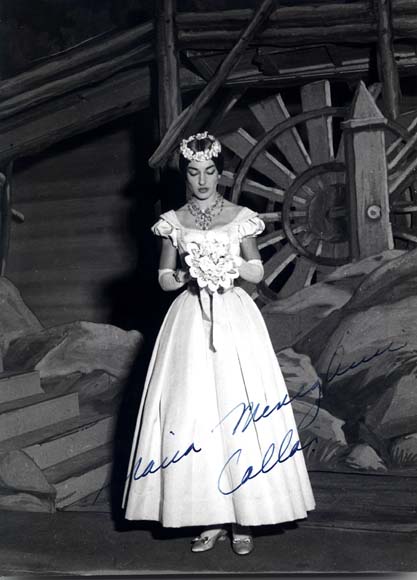
[Ears openers] III. Maria Callas


Everything has already been said and written about La Callas.
So I’m not gonna add another enthusiastic post from another unconditional fan.


I just wanted to let you be the judge.
I’ve selected 4 extracts from YouTube, from the 4 major female roles in Italian opera; Amina in Bellini’s La Sonnambula, Lucia from Donizetti’s Lucia di Lammermoor, Norma from Bellini’s Norma and Violetta from Verdi’s La Traviata.


I’m giving you the YouTube version of Maria Callas I prefer, as well as the other version I fancy (from anyone but Callas).

There’s no brainstorming on these extracts for me.
However great the other singer is (and I must admit Ciofi as Lucia, Gheorghiu as Violetta and Dessay as Amina are pretty amazing), Maria Callas is still singing in another galaxy.


Amina – La Sonnambula – two extracts from two recitals of the same aria, “Ah! non credea mirarti”
The Callas recital, the 2006 New York performance of Natalie Dessay.


Lucia – Lucia di Lammermoor – two live performances of the Mad Scene.
The Callas 1955 live from Berlin (part one, part two), the 2006 Orange performance of Patrizia Ciofi (part one, part two).


Norma – Norma – two live performances of “Casta Diva”
The Callas 1955 Opening night at La Scala (sound only), the 1974 Orange performance of Montserrat Caballé.


Violetta – La Traviata – two live performances of “Sempre libera”
The Callas 1951 live from Mexico City (sound only), the 1994 Covent Garden performance of Angela Gheorghiu.


Further readings

- An article published in Time Magazine on Callas, written by Cecilia Bartoli
- Interviews of Maria Callas in French (1965 and 1969), extracts from the INA archives (other extracts here)

- French site exclusively about Maria Callas
- La Divina Maria Callas (in Italian and in English)
- listing of main sites about Callas


Mar 20, 2007

[Ears openers] II. Ernest Blanc


One of the greatest French baritones, born Nov.1 1923, in Sanary-sur-Mer (near Toulon).


Ernest Blanc is one of those few singers I find unrivalled whatever role they’re singing.
Meaning, as soon as I hear their interpretation of one role, I find everyone else’s common and lacking something.


Ernest Blanc is beyond comparison.
Not only was his diction in French perfect, but his voice was magnificent.
Powerful, expressive, always right on the note, with an amazing consistency, perfect balance, extraordinary breath, unique dark timbre.


He learnt how to sing in the Conservatoire de Musique de Toulon, and made his debuts in Marseille in 1950 in Tonio.

His first role in Paris was Rigoletto in 1954; he sang in Lisbon (1958), was one of the only French singers ever invited to the Bayreuth Festival were he sang the role of Friedrich von Telramund in Lohengrin in 1958 and 1959 (with his wife Belgian mezzo-soprano Rita Gorr singing Ortrud in 1959); he also sang in Chicago and San Francisco (1959); La Scala and the Glyndebourne Festival (1960); Covent Garden in London (1961); the New York MET, the Berlin Deutsche Oper and Philadelphia (1963); Amsterdam (1964)...


Audio extract:

- "L'orage s'est calmé" from the beginning of Act III of Georges Bizet's Les Pêcheurs de Perles - "O sainte médaille", Gounod's Faust (Valentin aria) (YouTube, audio) - "Maudite à jamais soit la race", Saint-Saëns' Samson et Dalila (YouTube, audio)


A few roles he sang in Paris :


1955 : Opéra Garnier, Les Indes Galantes, JP Rameau
1952 production, Louis Fourestier conducting

Jan. 22 -
Van Herck (Hébé), Couderc (Bellone), Chalanda (L'Amour), Vaillant (Osman), Jacqueline Brumaire (Emilie), Jean Giraudeau (Valère), Ernest Blanc (Huascar), Suzanne Juyol (Phani), Huylbrock (Don Carlos), Alain Vanzo (Tacmas), Noguera (Ali), Guilhard (Zaïre), Angelici (Fatime), Camille Rouquetty (Adario), Roger Gardes (Damon), Clavère (Don Alvar), Berthe Monmart (Zima)

Oct. 29 -
Christiane Castelli (Hébé), Bouvier (Bellone), Chalanda (L'Amour), Xavier Depraz (Osman), Cumia (Emilie), Jean Giraudeau (Valère), Ernest Blanc (Huascar), Suzanne Juyol (Phani), Georges Doré (Don Carlos), Alain Vanzo (Tacmas), Noguera (Ali), Denise Duval (Zaïre), Angelici (Fatime), Verdière (Adario), Nicolaï Gedda (Damon), Clavère (Don Alvar), Gisèle Desmoutiers (Zima)

Dec. 10 -
Renée Doria (Hébé), Couderc (Bellone), Chalanda (L'Amour), Xavier Depraz (Osman), Cumia (Emilie), Henri Legay (Valère), Ernest Blanc (Huascar), Melvat (Phani), Romagnoni (Don Carlos), Alain Vanzo (Tacmas), Noguera (Ali), Guilhard (Zaïre), Angelici (Fatime), Verdière (Adario), Roger Gardes (Damon), Clavère (Don Alvar), Gisèle Desmoutiers (Zima)


1956: August 24, Opéra Garnier, Rigoletto, Verdi, (French traduction of Édouard Duprez)
Pierre Dervaux conducting
Renée Doria (Gilda), Suzanne Lefort (Madeleine), Raphaël Romagnoni (duc de Mantoue), Ernest Blanc (Rigoletto), André Philippe (Monterone) Charles Paul (Ceprano) Gérard Serkoyan (Sparafucile)


1956 : Mozart’s Don Gionvanni, staged by José Beckmans, Jacques Marillier’s settings
Ernest Blanc (Don Giovanni), Louis Noguéra (Leporello), Régine Crespin (Donna Anna) and Jacqueline Brumaire (Donna Elvira).


1980 : Boris Godounov, Modeste Moussorgsky
Ruggero Raimondi, Virioca Cortez, Ernest Blanc & Roger Soyer


A few roles he sang elsewhere:


1959 (Dec. 10)
Carmen
Chicago
Lovro von Matacic conducting
Don José – Giuseppe di Stefano
Escamillo – Ernest Blanc
Carmen – Jean Madeira
Micaëla – Dorothy Warenskjold


1960 (Jan.2)
Carmen
Scala, Milano
Nino Sanzogno conducting
Don José – Giuseppe di Stefano
Escamillo – Ernest Blanc
Carmen – Giulietta Simionato
Micaëla – Gabriella Tucci


DISCOGRAPHY


Faust, Charles Gounod
1958 André Cluytens; Chœurs et Orchestre du Théâtre National de l'Opéra de Paris
Victoria de los Angeles - Marguerite
Liliane Berton - Siébel
Rita Gorr - Marthe
Nicolai Gedda - Faust
Ernest Blanc - Valentin
Boris Christoff - Méphistophélès
Victor Autran - Wagner
HMW ALP 1721-4 (4 LP); EMI 769 983-2 (3 CD)


Lohengrin, Richard Wagner
1958 André Cluytens Bayreuth Festival Orchestra & chorus
Sándor Kónya - Lohengrin
Leonie Rysanek - Elsa
Kieth Engen - König Heinrich)
Ernest Blanc - Telramund
Astrid Varnay - Ortrud
Eberhard Waechter - Heerrufer
Réédition Myto 1994


Lohengrin, Richard Wagner
1959, Lovro von Matacic, Bayreuth Festival Orchestra & Chorus
Sandor Konya - Lohengrin
Elisabeth Grummer - Elsa
Eberhard Waechter - Heerrufer)
Ernest Blanc - Telramund
Rita Gorr - Ortrud
Franz Crass - König Heinrich
Golden Melodram


Carmen, Georges Bizet
1959 Thomas Beecham; Chœurs et Maîtrise de la Radiodiffusion Française, Orchestre National de la Radiodiffusion Française
Victoria de los Angeles - Carmen
Nicolai Gedda - Don José
Janine Micheau - Micaëla
Ernest Blanc - Escamillo
Denis Monteil - Frasquita
Monique Linval/Marcelle Croisier - Mercédès
Jean-Christophe Benoit - Dancaire
Michel Hamel - Remendado
HMW SLS 5021; EMI 556 214-2 (3 CD)

"Ernest Blanc, doté d'une voix très ferme, parfois presque dure, ou du moins rude et authentiquement formée, n'en possédait pas moins, en plus de l'autorité déjà évoquée dans le message précédent, une véritable élégance, apanage nécessaire de l'opéra. Quiconque a rencontré la version Beecham de Carmen doit reconnaître que la trivialité du propos a ici fait place à la nuance, au goût, au phrasé impeccablement géré. Ses ornementations et appoggiatures des couplets d'entrée d'Escamillo, tantôt fines évocations à l'espagnolade, tantôt murmures flatteurs, ne laissent pas d'enchanter,contrairement aux attaques forte de ses collègues, même les plus méritants, faisant de ce toast aux suggestions semi-érotiques un air de bravoure aussi discret que "Di quella pira" chanté par le néanmoins admirable Del Monaco."
Extract from OperaCritiques

"Ernest Blanc’s manly aristocratic voice and style fits exactly Escamillo - he is unrivalled in this role."
Extract from here


Les Pêcheurs de perles, Georges Bizet
1960 Pierre Dervaux; Chœurs et Orchestre du Théâtre de l'Opéra Comique ParisJanine Micheau - Lëila
Nicolai Gedda - Nadir
Ernest Blanc - Zurga
Jacques Mars - Nourabad
EMI SLS 877 (2 LP); EMI 566 020-2 (2 CD)


Louise, Gustave Charpentier
Sylvain Cambreling, Orchestre de l'Opéra National de Belgique
Felicity Lott - Louise
Rita Gorr - La mère
Ernest Blanc - Le père
Erato 8573-82298-2


Iphigénie en Tauride , Christoph Willibald Gluck
1961 Georges Prêtre; Orchestre des Concerts du Conservatoire
Rita Gorr - Iphigénie
Ernest Blanc - Oreste
Nicolai Gedda - Pylade
Louis Quilico - Thoas
EMI 29 1241 1 (LP), EMI 5 73090 2 (CD)


Lakmé, Léo Delibes
1962 Jésus Etcheverry, Orchestre Les Solistes de Paris
Gérard - Nicolai Gedda/Alain Vanzo
Lakmé - Gianna d' Angelo/Renée Doria
Mallika - Jane Berbié
Nilakantha - Ernest Blanc/Adrien Legros
Accord 149164, Accord 220 642 (CD)


Samson et Dalila, Camille St-Saëns
1962, Georges Prêtre, chœurs René Duclos, Orchestre du Theatre National de L'Opera de Paris
Jon ViIckers, Rita Gorr, Ernest Blanc, Anton Diakov, Remy Corazza, Jacques Potier, Jean-Pierre Hurteau
EMI 0724356759824


I puritani, Vincenzo Bellini
1963 Richard Bonynge, American Opera Society Chorus and Orchestra Philadelphia
Joan Sutherland - Elvira
Nicolai Gedda - Arturo Talbo
Ernest Blanc - Riccardo Forth
Justino Diaz - Giorgio Valton
SRO 838 (2 CD) (Live Recording from Philadelphia Academy of Music, April 18, 1963)


Samson et Dalila, Camille St-Saëns
Live version
1964 Jean Fournet, Groot Omroepkoor, Radio Filarmonisch Orkest
Jon Vickers: Samson
Oralia Dominguez - Dalila
Ernest Blanc - Le Grand-Pretre
Henk Driessen - Abimelech
Peter van der Bilt - Un Viellard Hebreu
Live version from Amsterdam, February 29, 1964


Les Contes d’Hoffman, Jacques Offenbach
1964-65 Andre Cluytens, choeurs René Duclos, Orchestre de la Société des Concerts du Conservatoire
Nicolaï Gedda - Hoffmann
George London - Coppélius, Miracle
Ernest Blanc - Dapertutto
Nicola Ghiuselev - Lindorf
Gianna d'Angelo - Olympia
Elisabeth Schwarzkopf - Giulietta
Victoria de Los Angeles - Antonia
Jean-Christophe Benoît - Nicklausse
Christiane Gayraud - La mère
Robert Geay - Crespel
Michel Sénéchal - Spalanzani
Jean-Pierre Laffage - Luther/Schlemil
Jacques Loreau - Andrès, Cochenille, Pitichinaccio, Frantz
André Mallabrera - Nathanaël
Jacques Pruvost - Hermann
EMI 0724356798359 (2CD)


L’Enfance du Christ, Hector Berlioz
1967 Andre Cluytens, choeurs René Duclos, Paris Conservatory Orchestra
Xavier Depraz, Remy Corazza, Bernard Cottret, Ernest Blanc, Victoria de Los Angeles, Roger Soyer, Nicolai Gedda


Herodiade, Jules Massenet
1974, David Lloyd-Jones, ORTF Lyric Orchestra
Pierre Thau, Michelle Martin, Nadine Denize, Ernest Blanc, Michel Philippe
Opera D'Oro ODO 1336, Released in 2002, Live recording May 12, 1974


Don Procopio, Georges Bizet
1975 Bruno Amaducci, Chœur et Orchestre Radio Lyrique de Paris
Jules Bastin - Don Procopio
Ernest Blanc - Don Andronico
Alain Vanzo - Don Odoardo
Robert Massard - Don Ernesto
Jean-Louis Soumagnas - Pasquino
Mady Mesplé - Donna Bettina
Lyliane Guitton - Donna Eufemia
MRF 177 (3 LP); UORC 297/Le Chant du Monde 278914 (1 CD) (extracts)


Djamileh, Georges Bizet
1975 Bruno Amaducci; Chœur et Orchestre Radio Lyrique de Paris
Christiane Eda-Pierre, Mady Mesplé, Ernest Blanc, Robert Massard
MRF 177 (Extracts)


Further readings:
- Wikipedia article (in French)

- From Abeille Musique Forum;
12-04-06 22:09
Ernest Blanc, qui doit habiter Toulon ou sa région, serait bien malade.
Ne l'oublions pas. Quelle voix et quelle diction !

Je viens de retrouver par hasard un article du Monde (17/18 déc 1978) suite à la reprise de Samson. Voici un extrait de cet article :
"ce qui... donne à cette série de représentations de Samson et Dalila une valeur exemplaire, c'est le retour d'Ernest Blanc dans ce rôle de Grand Prêtre.... Y a-t-il encore beaucoup de chanteurs français dont la diction soit aussi parfaite, qui sache joindre le mot à la musique, faisant rejaillir l'un sur l'autre selon les règles de la rhétorique ?... En l'écoutant chanter, on croit découvrir ce que devrait toujours être l'opéra."
Merci infiniment Monsieur Ernest Blanc.

Mar 19, 2007

[Ears openers] Introduction

Have you noticed how opera addicts tend to make a list of everything ? My ten favourite tenors, the 20 best sopranos, the 100 best singers ever, etc. ?
I have some issues doing that. Simply because the voice can change so quickly, for better or for worse, and also because opera is full of surprises. You might never know what you can discover, past or future performances.
Instead of yet another “top 10”, I’ve decided to start a new series, that I’ve untitled “ears openers”; people that have changed my vision of opera, hopefully with many more to come.
I’ve already written about Franco Corelli, who will be, for that matter, my first post of this series I’m launching.
A few names I often mention, on those to follow; Riccardo Muti, Maria Callas, Ernest Blanc, Nicolai Gedda, etc.

Jan 2, 2007

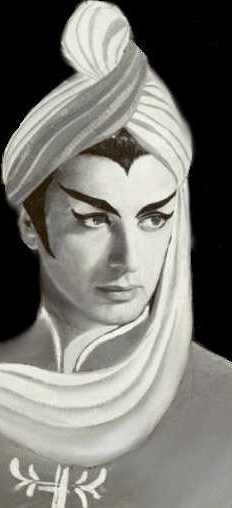
[Ears openers] I. Franco Corelli

Le plus beau,
le plus fort,
le plus grand.

Si!


Né à Ancône le 8 avril 1921 d'un ouvrier des chantiers navals, le petit Dario Corelli (son véritable prénom) se destine très tôt à la carrière d’ingénieur naval (à Ancône, capitale de la région des Marches, il n’existe guère d’autre salut) et effectue ses études à l’université de Bologne.
A 26 ans, il commence à fréquenter les conservatoires de Pesaro et Milan et quasi-autodidacte, perfectionne sa technique en écoutant inlassablement des enregistrements d’Enrico Caruso et Beniamino Gigli.

En 1951, il gagne le concours du Mai Musical de Florence, ce qui lui permet de faire ses débuts au festival de musique de Spolète le 26 août de la même année, dans le rôle de Don José (Carmen).

Dès lors, sa carrière est lancée.


Sa voix puissante et chaude est caractérisée par un vibrato qui ne plaît pas à tout le monde selon la formule de E. Stinchelli dans Le Stelle della lirica (Gremese Editore, Roma, 1986).
De même, les « sanglots » dont il parsème son chant suscitent un magnétisme viscéral ou des critiques acerbes. Personnellement, j’y suis particulièrement sensible tant son interprétation vocale est animale et captivante, pour reprendre les termes d’un critique lors de ses débuts au MET le 27 janvier 1961 avec Leontyne Price dans Il Trovatore de Verdi.


Parmi les instants phares de sa carrière, il faut retenir La Battaglia di Legnano, donnée à la Scala en 1961, en commémoration du centenaire de l’unité italienne (enregistrement live à posséder absolument) et les Don Carlo donnés au MET au début des années 60.

Malgré sa présence virile et héroïque sur scène, et son physique remarquable (trouvez moi un ténor à la beauté plastique plus parfait que Corelli, franchement), il souffre d'un trac terrible ; «On devait le pousser sur scène» (Renata Scotto).

Il fait partie de la distribution de ce Norma resté dans les annales de l’opéra, donné à Rome le 2 janvier 1958, au cours duquel la Callas quitte la scène définitivement à la fin du 1er acte, sous le regard impuissant du président de la république italienne de l’époque, Giovanni Gronchi.


Il a chanté avec toutes les grandes cantatrices de son temps, Maria Callas bien sûr (enregistrement magnifique de Norma en CD) , mais aussi Renato Scotto (Turandot de Puccini en CD), La Tebaldi (La Gioconda d'Amilcare Ponchielli en CD), Anita Cerquetti hélas oubliée (Norma disponible en CD), Birgit Nilsson (déjà dans la distribution du Turandot précédemment évoqué, également dans Aida disponible en CD), Elizabeth Schwarzkopf (Hercules d’Haendel version live à la Scala de 1958 en CD), Régine Crespin (Il Trovatore chanté en 1959 à Lisbonne, à ma connaissance non disponible en CD) , Leontyne Price (Il Trovatore version live de 1962 disponible en CD dirigée par Karajan, dans laquelle il chante l’air de la 3e partie « Ah !si, ben moi » à la perfection), Joan Sutherland (Les Hugenots de Meyerbeer chantés en italien en CD, ou Faust de Gounod en CD où Corelli est un Faust à tomber), Christa Ludwig (présente dans la distribution du Norma avec la Callas que j’ai déjà mentionné), Marilyn Horne (Carmen à Philadelphie en 1962, non édité en CD), Mirella Freni (Cavalleria Rusticana de Mascagni en CD).

Il cesse de chanter sur scène en 1976, à 55 ans, alors que sa voix est perdue. Il meurt le 29 octobre 2003 à Milan, où il est enterré au Cimitero Monumentale (l’équivalent milanais du Père Lachaise).

"We have lost one of the greatest tenors of the world. One of the greatest tenors of the century. He was the most serious of his profession, and he was a great interpreter who made great sacrifices for his career" Carlo Bergonzi.


Autres CDs indispensables :

Don Carlo de Verdi, La Forza del Destino de Verdi (version live de 1958) dirigée par Francesco Molinari Pradelli avec Renata Tebaldi, Ettore Bastianini, orchestre du théâtre San Carlo de Naples, en DVD (si si !), Andrea Chenier de Giordano.


Bio on the web:

Franco Corelli: Tenor of the Century by Joern H. Anthonisen; Forum Opéra, Wikipedia.


Extraits YouTube :
Andrea Chénier concert Tokyo 1971, avec Ettore Bastianini dans La forza del destino (sublime extrait), autre extrait de La Forza del Destino avec Ettore Bastianini (toujours aussi sublime) .


Extraits audio:

Adriana Lecouvreur de Francesco Cilea; Carmen, La fleur que tu m’avais jetée (chantée en italien), 1954; Core n’grato (live).


Liste complete de toutes les représentations chantées par Franco Corelli, de tous les enregistrements (opéras, récitals et autres) ici.